


Page 183 - Read Online
P. 183
Nam et al. Soft Sci 2023;3:28  https://dx.doi.org/10.20517/ss.2023.19            Page 7 of 35


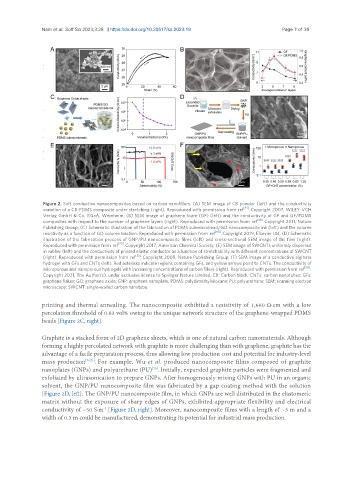
                Figure 2. Soft conductive nanocomposites based on carbon nanofillers. (A) SEM image of CB powder (left) and the conductivity
                                                                                   [45]
                variation of a CB-PDMS composite under stretching (right). Reproduced with permission from  ref  . Copyright 2007, WILEY-VCH
                Verlag GmbH & Co. KGaA, Weinheim; (B) SEM image of graphene foam (GF) (left) and the conductivity of GF and GF/PDMS
                                                                                        [48]
                composites with respect to the number of graphene layers (right). Reproduced with permission from  ref  . Copyright 2011, Nature
                Publishing Group; (C) Schematic illustration of the fabrication of PDMS submicrobead/GO nanocomposite ink (left) and the volume
                resistivity as a function of GO volume fraction. Reproduced with permission from  ref [68] . Copyright 2019, Elsevier Ltd; (D) Schematic
                illustration of the fabrication process of GNP/PU nanocomposite films (left) and cross-sectional SEM image of the film (right).
                Reproduced with permission from ref [70] . Copyright 2017, American Chemical Society; (E) SEM image of SWCNTs uniformly dispersed
                in rubber (left) and the conductivity of printed elastic conductor as a function of stretchability with different concentrations of SWCNT
                (right). Reproduced with permission from  ref [52] . Copyright 2009, Nature Publishing Group; (F) SEM image of a conductive alginate
                hydrogel with GFs and CNTs (left). Red asterisks indicate regions containing GFs, and yellow arrows point to CNTs. The conductivity of
                microporous and nanoporous hydrogels with increasing concentrations of carbon fillers (right). Reproduced with permission from ref [59] .
                Copyright 2021, The Author(s), under exclusive license to Springer Nature Limited. CB: Carbon black; CNTs: carbon nanotubes; GFs:
                graphene flakes; GO: graphene oxide; GNP: graphene nanoplate; PDMS: polydimethylsiloxane; PU: polyurethane; SEM: scanning electron
                microscopy; SWCNT: single-walled carbon nanotube.

               printing and thermal annealing. The nanocomposite exhibited a resistivity of 1,660 Ω·cm with a low
               percolation threshold of 0.83 vol% owing to the unique network structure of the graphene-wrapped PDMS
               beads [Figure 2C, right].

               Graphite is a stacked form of 2D graphene sheets, which is one of natural carbon nanomaterials. Although
               forming a highly percolated network with graphite is more challenging than with graphene, graphite has the
               advantage of a facile preparation process, thus allowing low production cost and potential for industry-level
               mass production [70,71] . For example, Wu et al. produced nanocomposite films composed of graphite
                                                    [70]
               nanoplates (GNPs) and polyurethane (PU) . Initially, expanded graphite particles were fragmented and
               exfoliated by ultrasonication to prepare GNPs. After homogenously mixing GNPs with PU in an organic
               solvent, the GNP/PU nanocomposite film was fabricated by a gap coating method with the solution
               [Figure 2D, left]. The GNP/PU nanocomposite film, in which GNPs are well distributed in the elastomeric
               matrix without the exposure of sharp edges of GNPs, exhibited appropriate flexibility and electrical
               conductivity of ~50 S·m  [Figure 2D, right]. Moreover, nanocomposite films with a length of ~3 m and a
                                    -1
               width of 0.3 m could be manufactured, demonstrating its potential for industrial mass production.

