


Page 187 - Read Online
P. 187
Nam et al. Soft Sci 2023;3:28  https://dx.doi.org/10.20517/ss.2023.19           Page 11 of 35


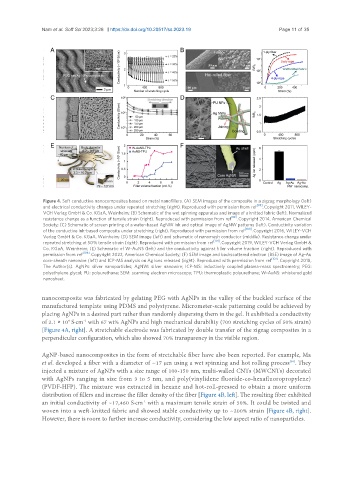
                Figure 4. Soft conductive nanocomposites based on metal nanofillers. (A) SEM images of the composite in a zigzag morphology (left)
                and electrical conductivity changes under repeated stretching (right). Reproduced with permission from ref [98] . Copyright 2011, WILEY-
                VCH Verlag GmbH & Co. KGaA, Weinheim; (B) Schematic of the wet spinning apparatus and image of a knitted fabric (left). Normalized
                resistance change as a function of tensile strain (right). Reproduced with permission from  ref [99] . Copyright 2014, American Chemical
                Society; (C) Schematic of screen printing of a water-based AgNW ink and optical image of AgNW patterns (left). Conductivity variation
                of the conductive ink-based composite under stretching (right). Reproduced with permission from ref [100] . Copyright 2016, WILEY-VCH
                Verlag GmbH & Co. KGaA, Weinheim; (D) SEM image (left) and schematic of nanomesh conductor (middle). Resistance change under
                repeated stretching at 50% tensile strain (right). Reproduced with permission from ref [101] . Copyright 2019, WILEY-VCH Verlag GmbH &
                Co. KGaA, Weinheim; (E) Schematic of W-AuNS (left) and the conductivity against filler volume fraction (right). Reproduced with
                permission from ref [106] . Copyright 2022, American Chemical Society; (F) SEM image and backscattered electron (BSE) image of Ag-Au
                core-sheath nanowire (left) and ICP-MS analysis on Ag ions released (right). Reproduced with permission from ref [107] . Copyright 2018,
                The  Author(s).  AgNPs:  silver  nanoparticles;  AgNW:  silver  nanowire;  ICP-MS:  inductively  coupled  plasma-mass  spectrometry;  PEG:
                polyethylene glycol; PU: polyurethane; SEM: scanning electron microscopy; TPU: thermoplastic polyurethane; W-AuNS: whiskered gold
                nanosheet.


               nanocomposite was fabricated by gelating PEG with AgNPs in the valley of the buckled surface of the
               manufactured template using PDMS and polystyrene. Micrometer-scale patterning could be achieved by
               placing AgNPs in a desired part rather than randomly dispersing them in the gel. It exhibited a conductivity
               of 2.1 × 10  S·cm  with 67 wt% AgNPs and high mechanical durability (700 stretching cycles of 50% strain)
                        4
                             -1
               [Figure 4A, right]. A stretchable electrode was fabricated by double transfer of the zigzag composites in a
               perpendicular configuration, which also showed 70% transparency in the visible region.

               AgNP-based nanocomposites in the form of stretchable fiber have also been reported. For example, Ma
                                                                                                   [99]
               et al. developed a fiber with a diameter of ~17 μm using a wet spinning and hot rolling process . They
               injected a mixture of AgNPs with a size range of 100-150 nm, multi-walled CNTs (MWCNTs) decorated
               with AgNPs ranging in size from 3 to 5 nm, and poly(vinylidene fluoride-co-hexafluoropropylene)
               (PVDF-HFP). The mixture was extracted in hexane and hot-roll-pressed to obtain a more uniform
               distribution of fillers and increase the filler density of the fiber [Figure 4B, left]. The resulting fiber exhibited
               an initial conductivity of ~17,460 S·cm  with a maximum tensile strain of 50%. It could be twisted and
                                                 -1
               woven into a weft-knitted fabric and showed stable conductivity up to ~200% strain [Figure 4B, right].
               However, there is room to further increase conductivity, considering the low aspect ratio of nanoparticles.

