


Page 190 - Read Online
P. 190
Page 14 of 35                           Nam et al. Soft Sci 2023;3:28  https://dx.doi.org/10.20517/ss.2023.19


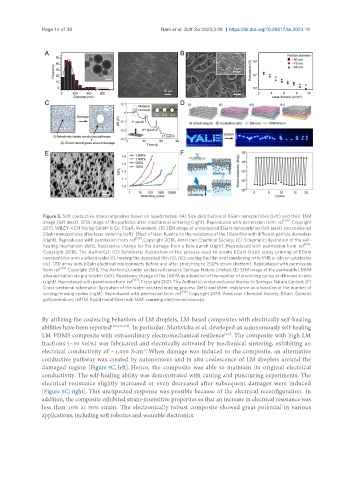
                Figure 5. Soft conductive nanocomposites based on liquid metals. (A) Size distribution of EGaIn nanoparticles (left) and their TEM
                                                                                                [126]
                image (left inset). SEM image of the particles after mechanical sintering (right). Reproduced with permission from  ref  . Copyright
                2015, WILEY-VCH Verlag GmbH & Co. KGaA, Weinheim; (B) SEM image of uncoalesced EGaIn nanoparticles (left inset) and coalesced
                EGaIn nanoparticles after laser sintering (left). Effect of laser fluence on the resistance of the EGaIn film with different particle diameters
                (right). Reproduced with permission from  ref [128] . Copyright 2018, American Chemical Society; (C) Schematic illustration of the self-
                healing mechanism (left). Resistance change for the damage from a hole punch (right). Reproduced with permission from  ref [131] .
                Copyright 2018, The Author(s); (D) Schematic illustration of the process used to create bGaIn (top): spray printing of EGaIn
                nanoparticles onto a silicon wafer (i); heating the deposited film (ii), (iii); cooling the film and transferring onto VHB or silicon substrates
                (iv). LED array with bGaIn electrical interconnects before and after stretching to 250% strain (bottom). Reproduced with permission
                from ref [133] . Copyright 2018, The Author(s), under exclusive license to Springer Nature Limited; (E) SEM image of the permeable LMFM
                after activation via pre-stretch (left). Resistance change of the LMFM as a function of the number of stretching cycles at different strains
                (right). Reproduced with permission from ref [137] . Copyright 2021, The Author(s), under exclusive license to Springer Nature Limited; (F)
                Cross-sectional schematic illustration of the water-assisted erasing process (left) and sheet resistance as a function of the number of
                writing/erasing cycles (right). Reproduced with permission from  ref [138] . Copyright 2019, American Chemical Society. EGaIn: Eutectic
                gallium-indium; LMFM: liquid metal fiber mat; SEM: scanning electron microscopy.

               By utilizing the coalescing behaviors of LM droplets, LM-based composites with electrically self-healing
               abilities have been reported [121,131,132] . In particular, Markvicka et al. developed an autonomously self-healing
                                                                             [131]
               LM-PDMS composite with extraordinary electromechanical resilience . The composite with high LM
               fractions (~50 vol%) was fabricated and electrically activated by mechanical sintering, exhibiting an
                                                 -1
               electrical conductivity of ~1,000 S·cm . When damage was induced to the composite, an alternative
               conductive pathway was created by autonomous and in situ coalescence of LM droplets around the
               damaged region [Figure 5C, left]. Hence, the composite was able to maintain its original electrical
               conductivity. The self-healing ability was demonstrated with cutting and puncturing experiments. The
               electrical resistance slightly increased or even decreased after subsequent damages were induced
               [Figure 5C, right]. This unexpected response was possible because of the electrical reconfiguration. In
               addition, the composite exhibited strain-insensitive properties so that an increase in electrical resistance was
               less than 10% at 50% strain. The electronically robust composite showed great potential in various
               applications, including soft robotics and wearable electronics.

