


Page 182 - Read Online
P. 182
Page 6 of 35                                                                       Nam et al. Soft Sci 2023;3:28  https://dx.doi.org/10.20517/ss.2023.19


                                                                                                               -1
                                                                          AgNW       PU      -          9,100 S·cm  310%     ΔR/R  = 45% at 50% strain  [101]
                                                                                                                                 0
                                                                          AgNW       SEBS    -          > 100,000   540%     ΔR/R  = 1,000% at 150%   [44]
                                                                                                                                 0
                                                                                                        S·cm -1              strain
                                                                                                               -1                    -1
                                                                          Ag-AuNW    SBS     60 wt%     41,850 S·cm  266%    10,000 S·cm  at 100% strain [107]
                                                                                                               -1
                                                                          Ag-Au-PtNW  SEBS   60 wt%     11,000 S·cm  480%    ΔR/R  < 1,000% at 200%   [37]
                                                                                                                                 0
                                                                                                                             strain
                                                                          AuNS       TPU     7.9 vol%   1,600 S·cm -1  200%  ΔR/R  = 800% at 200%   [106]
                                                                                                                                 0
                                                                                                                             strain
                                                                          AgNP/AgNW  SEBS    40 wt%/40   31,000 S·cm -1  800%  ΔR/R  = 0.26% at 50% strain [34]
                                                                                                                                 0
                                                                                             wt%
                Liquid metals  Strain insensitivity;     Biocompatibility;   EGaIn   PDMS    -          960 S·cm -1  -       -                   [126]
                             Theoretically infinite stretchability;   Need for encapsulation
                             Metal-like intrinsic conductivity            EGaIn      PDMS    50 vol%    1,370 S·cm -1  -     ΔR/R  < 10% at 50% strain  [131]
                                                                                                                                 0
                                                                          EGaIn      PDMS/VHB -         20,600 S·cm -1  1,200%  ΔR/R  = 6% at 100% strain  [133]
                                                                                                                                 0
                                                                          EGaIn      SBS     -          100 S·cm -1  1,800%  ΔR/R  = 40% at 1,800%   [137]
                                                                                                                                 0
                                                                                                                             strain
                                                                          EGaIn      PEGDA   10 vol%    5 Ω·sq -1  17%       -                   [138]
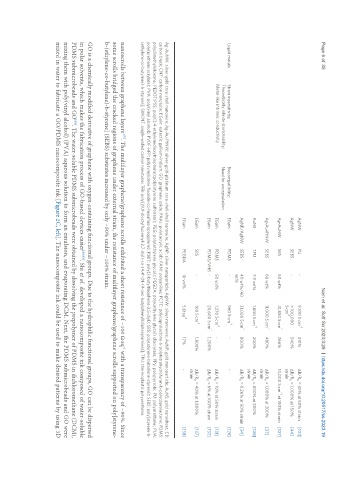
               Ag-AuNW: silver-gold core-shell nanowire; Ag-Au-PtNW: silver-gold-platinum core-shell-shell nanowire; AgNP: silver nanoparticle; AgNW: silver nanowire; AuNP: gold nanoparticle; AuNS: gold nanosheet; CB:
               carbon black; CNT: carbon nanotube; EGaIn: eutectic gallium-indium; GO: graphene oxide; PAAc: poly(acrylic acid); PANI: polyaniline; PCTC: polycaprolactone-b-polytetrahydrofuran-b-polycaprolactone; PDMS:
               polydimethylsiloxane; PEDOT:PSS: poly(3,4-ethylenedioxythiophene):poly(styrene sulfonate); PEG: poly(ethylene glycol); PEGDA: poly(ethylene glycol) diacrylate; PPy: polypyrrole; PU: polyurethane; PUA:
               poly(urethane acrylate); PVA: poly(vinyl alcohol); PVDF-HFP: poly(vinylidene fluoride-co-hexafluoropropylene); P3BT: poly(3-butylthiophene-2,5-diyl); SBS: poly(styrene-butadiene-styrene); SEBS: poly[styrene-b-
               (ethylene-co-butylene)-b-styrene]; SWCNT: single-walled carbon nanotube; TFB: poly[(9,9-dioctylfluorenyl-2,7-diyl)-co-(4,4’-(N-(4-sec-butylphenyl)diphenylamine)]; TPU: thermoplastic polyurethane.


                                              [67]
                                                                                                                      -1
               nanoscrolls between graphene layers . The multilayer graphene/graphene scrolls exhibited a sheet resistance of ~100 Ω·sq  with a transparency of ~90%. Since
               some scrolls bridged the cracked regions of graphene under external strain, the resistance of multilayer graphene/graphene scrolls supported on poly[styrene-
               b-(ethylene-co-butylene)-b-styrene] (SEBS) substrates increased by only ~50% under ~100% strain.
               GO is a chemically modified derivative of graphene with oxygen-containing functional groups. Due to the hydrophilic functional groups, GO can be dispersed
               in polar solvents, which makes the fabrication process of GO-based devices easier [68,69] . Shi et al. developed a nanocomposite ink composed of water-soluble
               PDMS submicrobeads and GO . The water-soluble PDMS submicrobeads were obtained by dissolving the prepolymer of PDMS in dichloromethane (DCM),
                                         [68]
               mixing them with poly(vinyl alcohol) (PVA) aqueous solution to form an emulsion, and evaporating DCM. Next, the PDMS submicrobeads and GO were
               mixed in water to fabricate a GO/PDMS nanocomposite ink [Figure 2C, left]. The nanocomposite ink could be used to make desired patterns by using 3D

