


Page 179 - Read Online
P. 179
Nam et al. Soft Sci 2023;3:28  https://dx.doi.org/10.20517/ss.2023.19            Page 3 of 35


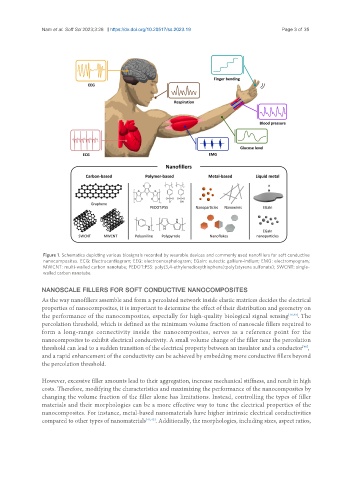
                Figure 1. Schematics depicting various biosignals recorded by wearable devices and commonly used nanofillers for soft conductive
                nanocomposites. ECG: Electrocardiogram; EEG: electroencephalogram; EGaIn: eutectic gallium-indium; EMG: electromyogram;
                MWCNT: multi-walled carbon nanotube; PEDOT:PSS: poly(3,4-ethylenedioxythiophene):poly(styrene sulfonate); SWCNT: single-
                walled carbon nanotube.

               NANOSCALE FILLERS FOR SOFT CONDUCTIVE NANOCOMPOSITES
               As the way nanofillers assemble and form a percolated network inside elastic matrices decides the electrical
               properties of nanocomposites, it is important to determine the effect of their distribution and geometry on
               the performance of the nanocomposites, especially for high-quality biological signal sensing [16,33] . The
               percolation threshold, which is defined as the minimum volume fraction of nanoscale fillers required to
               form  a  long-range  connectivity  inside  the  nanocomposites,  serves  as  a  reference  point  for  the
               nanocomposites to exhibit electrical conductivity. A small volume change of the filler near the percolation
               threshold can lead to a sudden transition of the electrical property between an insulator and a conductor ,
                                                                                                       [40]
               and a rapid enhancement of the conductivity can be achieved by embedding more conductive fillers beyond
               the percolation threshold.

               However, excessive filler amounts lead to their aggregation, increase mechanical stiffness, and result in high
               costs. Therefore, modifying the characteristics and maximizing the performance of the nanocomposites by
               changing the volume fraction of the filler alone has limitations. Instead, controlling the types of filler
               materials and their morphologies can be a more effective way to tune the electrical properties of the
               nanocomposites. For instance, metal-based nanomaterials have higher intrinsic electrical conductivities
               compared to other types of nanomaterials [41,42] . Additionally, the morphologies, including sizes, aspect ratios,

