


Page 156 - Read Online
P. 156
Page 4 of 9                             Guess et al. Soft Sci 2023;3:23  https://dx.doi.org/10.20517/ss.2023.17


               Table 1. Comparison of flexible SCG sensors
                          Sensor
                Reference                      Material      Transmission       Battery-free  Sensitivity
                          type
                This work  Capacitive strain sensor  Copper  LC resonance coupling  Yes     2 MHz per 1% ε
                [7]       Piezoelectric strain sensor  PVDF  Wired              No          0.4 mV per με
                [13]      Piezoelectric strain sensor  PVDF nanofiber  Wired    No          10 V per   Pa
                [18]      Piezoelectric strain sensor  PVDF  NFC                Yes         Not reported
                [14]      Fiber-optic strain sensor  Acrylate fiber  Wired      No          0.045 nm per mε
                [22]      Resistive strain sensor  Porous graphene  Wired       No          96 Ω per 1% ε

               NFC: near-field communication; PVDF: Polyvinylidene fluoride; ε: strain.


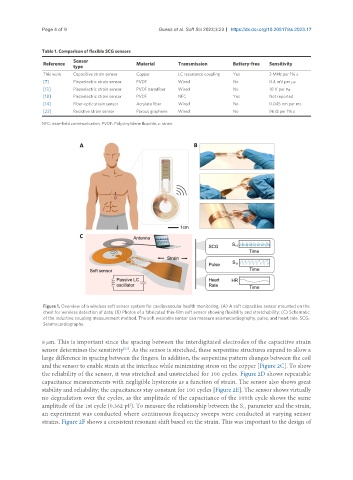
                Figure 1. Overview of a wireless soft sensor system for cardiovascular health monitoring. (A) A soft capacitive sensor mounted on the
                chest for wireless detection of data; (B) Photos of a fabricated thin-film soft sensor showing flexibility and stretchability; (C) Schematic
                of the inductive coupling measurement method. The soft wearable sensor can measure seismocardiography, pulse, and heart rate. SCG:
                Seismocardiography.

               8 μm. This is important since the spacing between the interdigitated electrodes of the capacitive strain
               sensor determines the sensitivity . As the sensor is stretched, these serpentine structures expand to allow a
                                           [23]
               large difference in spacing between the fingers. In addition, the serpentine pattern changes between the coil
               and the sensor to enable strain at the interface while minimizing stress on the copper [Figure 2C]. To show
               the reliability of the sensor, it was stretched and unstretched for 100 cycles. Figure 2D shows repeatable
               capacitance measurements with negligible hysteresis as a function of strain. The sensor also shows great
               stability and reliability; the capacitances stay constant for 100 cycles [Figure 2E]. The sensor shows virtually
               no degradation over the cycles, as the amplitude of the capacitance of the 100th cycle shows the same
               amplitude of the 1st cycle (0.362 pF). To measure the relationship between the S  parameter and the strain,
                                                                                   11
               an experiment was conducted where continuous frequency sweeps were conducted at varying sensor
               strains. Figure 2F shows a consistent resonant shift based on the strain. This was important to the design of

