


Page 159 - Read Online
P. 159
Guess et al. Soft Sci 2023;3:23  https://dx.doi.org/10.20517/ss.2023.17           Page 7 of 9


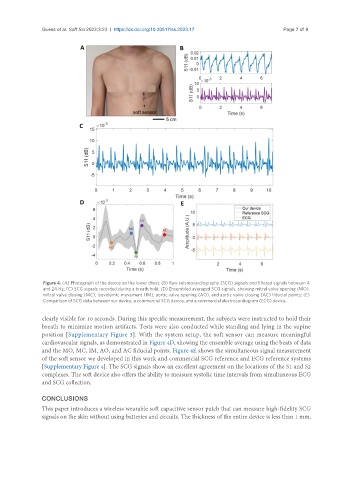
                Figure 4. (A) Photograph of the device on the lower chest; (B) Raw seismocardiography (SCG) signals and filtered signals between 4
                and 24 Hz; (C) SCG signals recorded during a breath hold; (D) Ensembled averaged SCG signals, showing mitral valve opening (MO),
                mitral valve closing (MC), isovolumic movement (IM), aortic valve opening (AO), and aortic valve closing (AC) fiducial points; (E)
                Comparison of SCG data between our device, a commercial SCG device, and a commercial electrocardiogram (ECG) device.

               clearly visible for 10 seconds. During this specific measurement, the subjects were instructed to hold their
               breath to minimize motion artifacts. Tests were also conducted while standing and lying in the supine
               position [Supplementary Figure 3]. With the system setup, the soft sensor can measure meaningful
               cardiovascular signals, as demonstrated in Figure 4D, showing the ensemble average using the beats of data
               and the MO, MC, IM, AO, and AC fiducial points. Figure 4E shows the simultaneous signal measurement
               of the soft sensor we developed in this work and commercial SCG reference and ECG reference systems
               [Supplementary Figure 4]. The SCG signals show an excellent agreement on the locations of the S1 and S2
               complexes. The soft device also offers the ability to measure systolic time intervals from simultaneous ECG
               and SCG collection.

               CONCLUSIONS
               This paper introduces a wireless wearable soft capacitive sensor patch that can measure high-fidelity SCG
               signals on the skin without using batteries and circuits. The thickness of the entire device is less than 1 mm,

