


Page 30 - Read Online
P. 30
Preto et al. Plast Aesthet Res. 2025;12:28  https://dx.doi.org/10.20517/2347-9264.2025.26  Page 11 of 17

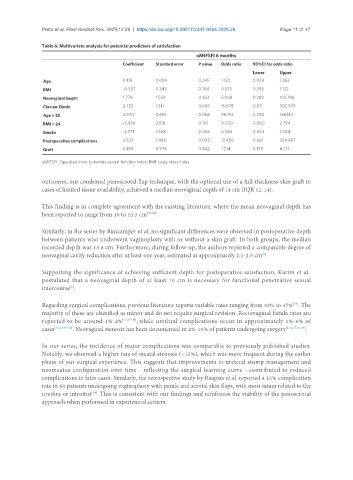
               Table 6. Multivariate analysis for potential predictors of satisfaction
                                                                   oMtFSFI 6 months
                                          Coefficient  Standard error  P value  Odds ratio  95%CI for odds ratio
                                                                                      Lower    Upper
                Age                       0.115      0.099          0.245   1.122     0.924    1.363
                BMI                       -0.557     0.343          0.104   0.573     0.292    1.122
                Neovaginal length         1.776      1.552          0.253   5.908     0.282    123.798
                Clavien-Dindo             2.752      1.511          0.069   15.678    0.811    302.979
                Age > 35                  4.574      2.485          0.066   96.912    0.744    12631.3
                BMI > 24                  -3.934     2.518          0.118   0.020     0.000    2.724
                Smoke                     -2.771     1.508          0.066   0.063     0.003    1.204
                Postoperative complications  2.522   1.498          0.092   12.459    0.661    234.687
                Graft                     0.194      0.976          0.842   1.214     0.179    8.217

               oMtFSFI: Operated male-to-female sexual function index; BMI: body mass index.

               outcomes, our combined penoscrotal flap technique, with the optional use of a full-thickness skin graft in
               cases of limited tissue availability, achieved a median neovaginal depth of 14 cm (IQR 12-14).


               This finding is in complete agreement with the existing literature, where the mean neovaginal depth has
               been reported to range from 10 to 13.5 cm [27,28] .


               Similarly, in the series by Buncamper et al, no significant differences were observed in postoperative depth
               between patients who underwent vaginoplasty with or without a skin graft. In both groups, the median
               recorded depth was 13.8 cm. Furthermore, during follow-up, the authors reported a comparable degree of
               neovaginal cavity reduction after at least one year, estimated at approximately 2.1-2.5 cm .
                                                                                         [6]
               Supporting the significance of achieving sufficient depth for postoperative satisfaction, Karim et al.
               postulated that a neovaginal depth of at least 10 cm is necessary for functional penetrative sexual
               intercourse .
                         [5]
               Regarding surgical complications, previous literature reports variable rates ranging from 33% to 47% . The
                                                                                                    [29]
               majority of these are classified as minor and do not require surgical revision. Rectovaginal fistula rates are
               reported to be around 1%-2% [12,27-29] , while urethral complications occur in approximately 1%-6% of
               cases [12,27,30-32] . Neovaginal stenosis has been documented in 2%-10% of patients undergoing surgery [2,12,27,31,33] .


               In our series, the incidence of major complications was comparable to previously published studies.
               Notably, we observed a higher rate of meatal stenosis (~15%), which was more frequent during the earlier
               phase of our surgical experience. This suggests that improvements in ureteral stump management and
               neomeatus configuration over time - reflecting the surgical learning curve - contributed to reduced
               complications in later cases. Similarly, the retrospective study by Raigosa et al. reported a 15% complication
               rate in 60 patients undergoing vaginoplasty with penile and scrotal skin flaps, with most issues related to the
               urethra or introitus . This is consistent with our findings and reinforces the viability of the penoscrotal
                                [34]
               approach when performed in experienced centers.

