


Page 29 - Read Online
P. 29
Page 10 of 17             Preto et al. Plast Aesthet Res. 2025;12:28  https://dx.doi.org/10.20517/2347-9264.2025.26

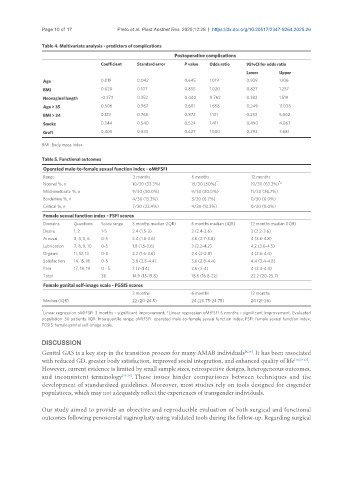
               Table 4. Multivariate analysis - predictors of complications
                                                            Postoperative complications
                                   Coefficient  Standard error  P value  Odds ratio  95%CI for odds ratio
                                                                                    Lower      Upper
                Age                0.019       0.042           0.645    1.019       0.939      1.106
                BMI                0.020       0.107           0.855    1.020       0.827      1.257
                Neovaginal length  -0.272      0.352           0.440    0.762       0.382      1.519
                Age > 35           0.506       0.967           0.601    1.658       0.249      11.038
                BMI > 24           0.123       0.765           0.872    1.131       0.253      5.062
                Smoke              0.344       0.540           0.524    1.411       0.490      4.067
                Graft              0.405       0.833           0.627    1.500       0.293      7.681

               BMI: Body mass index.

               Table 5. Functional outcomes
                Operated male-to-female sexual function index - oMtFSFI
                Range                                                                              3 months                                         6 months                                          12 months
                                                                          *                    *
                Normal %, n                   10/30 (33.3%)       15/30 (50%)         19/30 (63.3%) °
                Mild-moderate %, n            9/30 (30.0%)        9/30 (30.0%)        11/30 (36.7%)
                Borderline %, n               4/30 (13.3%)        3/30 (6.7%)         0/30 (0.0%)
                Critical %, n                 7/30 (23.4%)        4/30 (13.3%)        0/30 (0.0%)
                Female sexual function index - FSFI scores
                Domains   Questions  Score range  3 months median (IQR)  6 months median (IQR)  12 months median (IQR)
                Desire    1, 2     1-5        2.4 (1.5-3)         3 (2.4-3.6)         3 (2.2-3.6)
                Arousal   3, 4, 5, 6  0-5     2.4 (1.8-3.6)       3.6 (2.7-3.8)       4 (3.6-4.8)
                Lubrication  7, 8, 9, 10  0-5  1.8 (1.5-3.6)      3 (2.2-4.2)         4.2 (3.6-4.5)
                Orgasm    11, 12, 13  0-5     2.2 (1.6-3.6)       2.4 (2-2.8)         4 (3.6-4.4)
                Satisfaction  14, 15, 16  0-5  3.8 (2.8-4.4)      3.6 (2.8-4.4)       4.4 (3.4-4.8)
                Pain      17, 18, 19  0 - 5   3 (2-4.4)           3.6 (3-4)           4 (3.4-4.4)
                Total              36         14.9 (13-19.8)      18.6 (16.8-22)      22.2 (20-25.7)
                Female genital self-image scale - FGSIS scores
                                              3 months            6 months            12 months
                Median (IQR)                  22 (20-24.5)        24 (20.75-24.75)    24 (21-26)
               *
                Linear regression oMtFSFI 3 months - significant improvement; °Linear regression oMtFSFI 6 months - significant improvement. Evaluated
               population: 30 patients. IQR: Interquartile range; oMtFSFI: operated male-to-female sexual function index; FSFI: female sexual function index;
               FGSIS: female genital self-image scale.


               DISCUSSION
               Genital GAS is a key step in the transition process for many AMAB individuals [4,19] . It has been associated
               with reduced GD, greater body satisfaction, improved social integration, and enhanced quality of life [10,20-23] .
               However, current evidence is limited by small sample sizes, retrospective designs, heterogeneous outcomes,
               and  inconsistent  terminology [24-26] . These  issues  hinder  comparisons  between  techniques  and  the
               development of standardized guidelines. Moreover, most studies rely on tools designed for cisgender
               populations, which may not adequately reflect the experiences of transgender individuals.

               Our study aimed to provide an objective and reproducible evaluation of both surgical and functional
               outcomes following penoscrotal vaginoplasty using validated tools during the follow-up. Regarding surgical

