


Page 26 - Read Online
P. 26
Preto et al. Plast Aesthet Res. 2025;12:28  https://dx.doi.org/10.20517/2347-9264.2025.26  Page 7 of 17

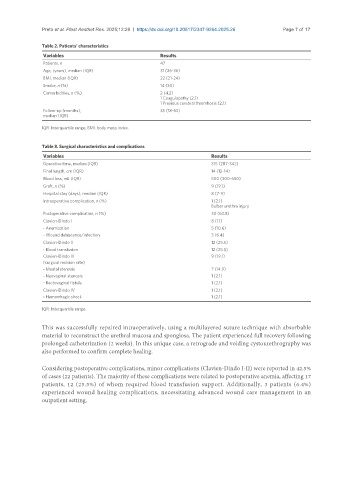
               Table 2. Patients’ characteristics
                Variables                              Results
                Patients, n                            47
                Age, (years), median (IQR)             31 (26-36)
                BMI, median (IQR)                      22 (21-24)
                Smoke, n (%)                           14 (30)
                Comorbidities, n (%)                   2 (4.2)
                                                       1 Coagulopathy (2.1)
                                                       1 Previous cerebral thrombosis (2.1)
                Follow-up (months),                    35 (18-62)
                median (IQR)
               IQR: Interquartile range; BMI: body mass index.


               Table 3. Surgical characteristics and complications
                Variables                                               Results
                Operative time, median (IQR)                            315 (287-342)
                Final length, cm (IQR)                                  14 (12-14)
                Blood loss, mL (IQR)                                    500 (300-650)
                Graft, n (%)                                            9 (19.1)
                Hospital stay (days), median (IQR)                      8 (7-9)
                Intraoperative complication, n (%)                      1 (2.1)
                                                                        Bulbar urethra injury
                Postoperative complication, n (%)                       30 (63.8)
                Clavien-Dindo I                                         8 (17)
                  - Anemization                                           5 (10.6)
                - Wound dehiscence/infection                            3 (6.4)
                Clavien-Dindo II                                        12 (25.5)

                - Blood transfusion                                     12 (25.5)

                Clavien-Dindo III                                       9 (19.1)
                (surgical revision rate)

                - Meatal stenosis                                       7 (14.9)
                - Neovaginal stenosis                                   1 (2.1)
                - Rectovaginal fistula                                  1 (2.1)
                Clavien-Dindo IV                                        1 (2.1)


                - Hemorrhagic shock                                     1 (2.1)
               IQR: Interquartile range.

               This was successfully repaired intraoperatively, using a multilayered suture technique with absorbable
               material to reconstruct the urethral mucosa and spongiosa. The patient experienced full recovery following
               prolonged catheterization (2 weeks). In this unique case, a retrograde and voiding cystourethrography was
               also performed to confirm complete healing.


               Considering postoperative complications, minor complications (Clavien-Dindo I-II) were reported in 42.5%
               of cases (22 patients). The majority of these complications were related to postoperative anemia, affecting 17
               patients, 12 (25.5%) of whom required blood transfusion support. Additionally, 3 patients (6.4%)
               experienced wound healing complications, necessitating advanced wound care management in an
               outpatient setting.

