


Page 25 - Read Online
P. 25
Son et al. Microbiome Res Rep. 2025;4:29  https://dx.doi.org/10.20517/mrr.2025.14  Page 7 of 19


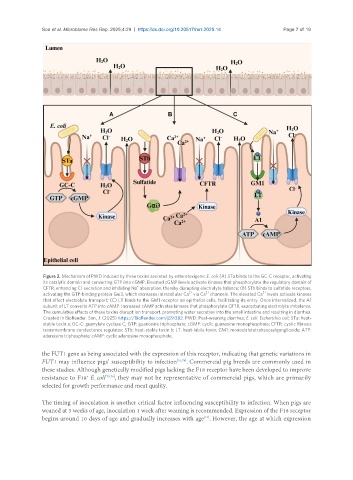
                Figure 2. Mechanism of PWD induced by three toxins secreted by enterotoxigenic E. coli. (A) STa binds to the GC-C receptor, activating
                its catalytic domain and converting GTP into cGMP. Elevated cGMP levels activate kinases that phosphorylate the regulatory domain of
                             -
                                               +
                CFTR, enhancing Cl  secretion and inhibiting Na  absorption, thereby disrupting electrolyte balance; (B) STb binds to sulfatide receptors,
                                                                      2+
                                                                 2+
                                                                                          2+
                activating the GTP-binding protein Gαi3, which increases intracellular Ca  via Ca  channels. The elevated Ca  levels activate kinases
                that affect electrolyte transport; (C) LT binds to the GM1 receptor on epithelial cells, facilitating its entry. Once internalized, the A1
                subunit of LT converts ATP into cAMP. Increased cAMP activates kinases that phosphorylate CFTR, exacerbating electrolyte imbalance.
                The cumulative effects of these toxins disrupt ion transport, promoting water secretion into the small intestine and resulting in diarrhea.
                Created in BioRender. Son, J. (2025) https://BioRender.com/j39i382. PWD: Post-weaning diarrhea; E. coli: Escherichia coli; STa: heat-
                stable toxin a; GC-C: guanylate cyclase C; GTP: guanosine triphosphate; cGMP: cyclic guanosine monophosphate; CFTR: cystic fibrosis
                transmembrane conductance regulator; STb: heat-stable toxin b; LT: heat-labile toxin; GM1: monosialotetrahexosylganglioside; ATP:
                adenosine triphosphate; cAMP: cyclic adenosine monophosphate.
               the FUT1 gene as being associated with the expression of this receptor, indicating that genetic variations in
               FUT1 may influence pigs’ susceptibility to infection [51,74] . Commercial pig breeds are commonly used in
               these studies. Although genetically modified pigs lacking the F18 receptor have been developed to improve
               resistance to F18  E. coli [75,76] , they may not be representative of commercial pigs, which are primarily
                              +
               selected for growth performance and meat quality.

               The timing of inoculation is another critical factor influencing susceptibility to infection. When pigs are
               weaned at 3 weeks of age, inoculation 1 week after weaning is recommended. Expression of the F18 receptor
               begins around 10 days of age and gradually increases with age . However, the age at which expression
                                                                      [14]

