


Page 21 - Read Online
P. 21
Son et al. Microbiome Res Rep. 2025;4:29  https://dx.doi.org/10.20517/mrr.2025.14  Page 3 of 19

                                                                                 +
                                                                           +
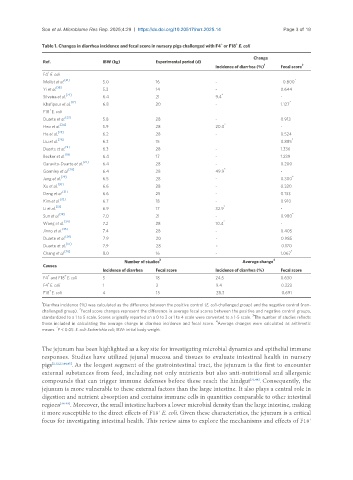
               Table 1. Changes in diarrhea incidence and fecal score in nursery pigs challenged with F4  or F18  E. coli
                                                                                      Change
                Ref.                IBW (kg)         Experimental period (d)
                                                                          Incidence of diarrhea (%) 1  Fecal score 2
                 +
                F4 E. coli
                       [21]                                                                         *
                Molist et al.       5.0               16                  -                     –0.800
                Yi et al. [16]      5.3               14                  -                     0.644
                       [22]                                                 *
                Silveira et al.     6.4               21                  9.4                   -
                Khafipour et al. [17]  6.8            20                  -                     1.127 *
                  +
                F18 E. coli
                       [23]
                Duarte et al.       5.8               28                  -                     0.913
                     [24]                                                    *
                Heo et al.          5.9               28                  20.0                  -
                     [25]
                He et al.           6.2               28                  -                     0.524
                Liu et al. [26]     6.3               15                                        0.885 *
                       [9]
                Duarte et al.       6.3               28                  -                     1.336
                Becker et al. [18]  6.4               17                  -                     1.239
                             [27]
                Garavito-Duarte et al.  6.4           28                  -                     0.200
                Gormley et al. [28]  6.4              28                  49.9 *                -
                      [29]                                                                          *
                Jang et al.         6.5               28                  -                     0.300
                Xu et al. [30]      6.6               28                  -                     0.320
                      [31]
                Deng et al.         6.6               25                  -                     0.133
                     [32]
                Kim et al.          6.7               18                  -                     0.910
                    [33]                                                    *
                Li et al.           6.9               17                  32.9                  -
                     [19]                                                                           *
                Sun et al.          7.0               21                  -                     0.980
                Wong et al. [34]    7.2               28                  10.4 *                -
                      [35]
                Jinno et al.        7.4               28                  -                     0.405
                Duarte et al.  [36]  7.9              20                  -                     0.985
                       [37]
                Duarte et al.       7.9               28                  -                     0.170
                Chang et al. [20]   8.0               16                  -                     1.067 *
                                           Number of studies 3                      Average change 4
                Causes
                                    Incidence of diarrhea  Fecal score    Incidence of diarrhea (%)  Fecal score
                 +     +
                F4  and F18 E. coli  5                18                  24.5                  0.630
                 +
                F4 E. coli          1                 3                   9.4                   0.323
                  +
                F18 E. coli         4                 15                  28.3                  0.691
               1
                Diarrhea incidence (%) was calculated as the difference between the positive control (E. coli-challenged group) and the negative control (non-
                            2
               challenged group).  Fecal score changes represent the difference in average fecal scores between the positive and negative control groups,
                                                                                      3
               standardized to a 1 to 5 scale. Scores originally reported on a 0 to 3 or 1 to 4 scale were converted to a 1-5 scale.  The number of studies reflects
                                                                          4
               those included  in  calculating  the  average  change  in  diarrhea  incidence  and  fecal  score.  Average  changes  were  calculated  as  arithmetic
                    *
               means.  P < 0.05. E. coli: Escherichia coli; IBW: initial body weight.
               The jejunum has been highlighted as a key site for investigating microbial dynamics and epithelial immune
               responses. Studies have utilized jejunal mucosa and tissues to evaluate intestinal health in nursery
               pigs [2,12,23,44,45] . As the longest segment of the gastrointestinal tract, the jejunum is the first to encounter
               external substances from feed, including not only nutrients but also anti-nutritional and allergenic
               compounds that can trigger immune defenses before these reach the hindgut [31,44] . Consequently, the
               jejunum is more vulnerable to these external factors than the large intestine. It also plays a central role in
               digestion and nutrient absorption and contains immune cells in quantities comparable to other intestinal
               regions [46-48] . Moreover, the small intestine harbors a lower microbial density than the large intestine, making
               it more susceptible to the direct effects of F18  E. coli. Given these characteristics, the jejunum is a critical
                                                      +
                                                                                                         +
               focus for investigating intestinal health. This review aims to explore the mechanisms and effects of F18

