


Page 22 - Read Online
P. 22
Page 4 of 19                   Son et al. Microbiome Res Rep. 2025;4:29  https://dx.doi.org/10.20517/mrr.2025.14

                                                                   +
                                                                        +
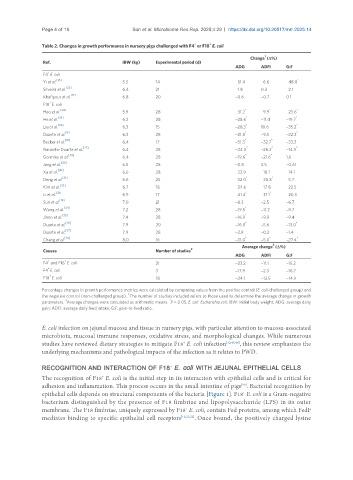
               Table 2. Changes in growth performance in nursery pigs challenged with F4  or F18  E. coli
                                                                                          1
                                                                                                                                                                                             Change  (Δ%)
                Ref.                      IBW (kg)    Experimental period (d)
                                                                                ADG      ADFI     G:F
                 +
                F4 E. coli
                    [16]                                                                             *
                Yi et al.                 5.3         14                        –51.4    –6.6     –48.0
                       [22]
                Silveira et al.           6.4         21                        –1.8     0.3      –2.1
                Khafipour et al. [17]     6.8         20                        –0.6     –0.7     0.1
                  +
                F18 E. coli
                Heo et al. [24]           5.9         28                        –31.2 *  –9.9 *   –23.6 *
                     [25]                                                           *                *
                He et al.                 6.2         28                        –28.6    –11.4    –19.7
                     [26]                                                           *                *
                Liu et al.                6.3         15                        –28.3    10.6     –35.2
                Duarte et al. [9]         6.3         28                        –21.8 *  –9.5     –22.2 *
                       [18]                                                         *       *
                Becker et al.             6.4         17                        –51.3    –32.7    –33.3
                             [27]                                                   *        *       *
                Garavito-Duarte et al.    6.4         28                        –24.0    –26.2    –14.9
                Gormley et al. [28]       6.4         28                        –19.6 *  –21.6 *  1.6
                      [29]
                Jang et al.               6.5         28                        –0.8     5.5      –0.61
                    [30]
                Xu et al.                 6.6         28                        –23.9    –18.1    –14.1
                Deng et al. [31]          6.6         25                        –32.0 *  –28.8 *  –5.7
                     [32]
                Kim et al.                6.7         18                        –34.6    –17.8    –23.5
                    [33]                                                            *       *
                Li et al.                 6.9         17                        –41.4    –31.1    –20.3
                Sun et al. [19]           7.0         21                        –8.3     –2.5     –6.7
                       [34]                                                         *
                Wong et al.               7.2         28                        –19.5    –11.2    –9.7
                      [35]                                                          *
                Jinno et al.              7.4         28                        –16.9    –9.9     –9.4
                Duarte et al. [36]        7.9         20                        –16.8 *  –5.6     –13.0 *
                       [37]
                Duarte et al.             7.9         28                        –2.9     –0.2     –1.4
                       [20]                                                         *       *        *
                Chang et al.              8.0         16                        –31.0    –5.0     –27.4
                                                                                             3
                                                                                   Average change  (Δ%)
                                                                 2
                Causes                                Number of studies
                                                                                ADG      ADFI     G:F
                 +     +
                F4  and F18 E. coli                   21                        –23.2    –11.1    –15.2
                 +
                F4 E. coli                            3                         –17.9    –2.3     –16.7
                  +
                F18 E. coli                           18                        –24.1    –12.5    –14.9
               Percentage changes in growth performance metrics were calculated by comparing values from the positive control (E. coli-challenged group) and
                                            2
               the negative control (non-challenged group).  The number of studies included refers to those used to determine the average change in growth
                       3                                  *
               parameters.  Average changes were calculated as arithmetic means.  P < 0.05. E. coli: Escherichia coli; IBW: initial body weight; ADG: average daily
               gain; ADFI: average daily feed intake; G:F: gain-to-feed ratio.
               E. coli infection on jejunal mucosa and tissue in nursery pigs, with particular attention to mucosa-associated
               microbiota, mucosal immune responses, oxidative stress, and morphological changes. While numerous
               studies have reviewed dietary strategies to mitigate F18  E. coli infection [12,45,49] , this review emphasizes the
                                                               +
               underlying mechanisms and pathological impacts of the infection as it relates to PWD.
               RECOGNITION AND INTERACTION OF F18  E.  coli  WITH JEJUNAL EPITHELIAL CELLS
                                                          +
               The recognition of F18  E. coli is the initial step in its interaction with epithelial cells and is critical for
                                   +
               adhesion and inflammation. This process occurs in the small intestine of pigs . Bacterial recognition by
                                                                                  [50]
                                                                                   +
               epithelial cells depends on structural components of the bacteria [Figure 1]. F18  E. coli is a Gram-negative
               bacterium distinguished by the presence of F18 fimbriae and lipopolysaccharide (LPS) in its outer
               membrane. The F18 fimbriae, uniquely expressed by F18  E. coli, contain Fed proteins, among which FedF
                                                                +
               mediates binding to specific epithelial cell receptors [12,51,52] . Once bound, the positively charged lysine

