


Page 66 - Read Online
P. 66
Tang et al. Mini-invasive Surg 2024;8:24  https://dx.doi.org/10.20517/2574-1225.2024.04  Page 9 of 13


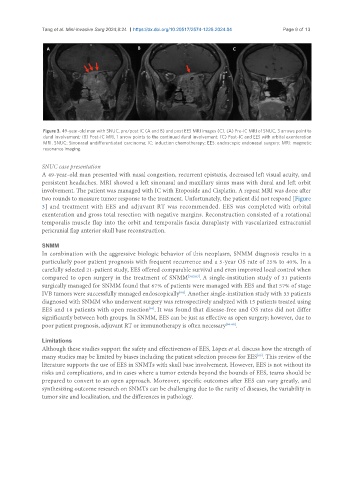
                Figure 3. 49-year-old man with SNUC, pre/post IC (A and B) and post EES MRI images (C). (A) Pre-IC MRI of SNUC, 3 arrows point to
                dural involvement; (B) Post-IC MRI, 1 arrow points to the continued dural involvement; (C) Post-IC and EES with orbital exenteration
                MRI. SNUC: Sinonasal undifferentiated carcinoma; IC: induction chemotherapy; EES: endoscopic endonasal surgery; MRI: magnetic
                resonance imaging.

               SNUC case presentation
               A 49-year-old man presented with nasal congestion, recurrent epistaxis, decreased left visual acuity, and
               persistent headaches. MRI showed a left sinonasal and maxillary sinus mass with dural and left orbit
               involvement. The patient was managed with IC with Etoposide and Cisplatin. A repeat MRI was done after
               two rounds to measure tumor response to the treatment. Unfortunately, the patient did not respond [Figure
               3] and treatment with EES and adjuvant RT was recommended. EES was completed with orbital
               exenteration and gross total resection with negative margins. Reconstruction consisted of a rotational
               temporalis muscle flap into the orbit and temporalis fascia duraplasty with vascularized extracranial
               pericranial flap anterior skull base reconstruction.

               SNMM
               In combination with the aggressive biologic behavior of this neoplasm, SNMM diagnosis results in a
               particularly poor patient prognosis with frequent recurrence and a 5-year OS rate of 25% to 40%. In a
               carefully selected 21-patient study, EES offered comparable survival and even improved local control when
               compared to open surgery in the treatment of SNMM [3,62,63] . A single-institution study of 31 patients
               surgically managed for SNMM found that 67% of patients were managed with EES and that 57% of stage
               IVB tumors were successfully managed endoscopically . Another single-institution study with 33 patients
                                                             [64]
               diagnosed with SNMM who underwent surgery was retrospectively analyzed with 15 patients treated using
               EES and 18 patients with open resection . It was found that disease-free and OS rates did not differ
                                                   [65]
               significantly between both groups. In SNMM, EES can be just as effective as open surgery; however, due to
               poor patient prognosis, adjuvant RT or immunotherapy is often necessary [66-68] .

               Limitations
               Although these studies support the safety and effectiveness of EES, López et al. discuss how the strength of
               many studies may be limited by biases including the patient selection process for EES . This review of the
                                                                                        [69]
               literature supports the use of EES in SNMTs with skull base involvement. However, EES is not without its
               risks and complications, and in cases where a tumor extends beyond the bounds of EES, teams should be
               prepared to convert to an open approach. Moreover, specific outcomes after EES can vary greatly, and
               synthesizing outcome research on SNMTs can be challenging due to the rarity of diseases, the variability in
               tumor size and localization, and the differences in pathology.

