


Page 64 - Read Online
P. 64
Tang et al. Mini-invasive Surg 2024;8:24  https://dx.doi.org/10.20517/2574-1225.2024.04  Page 7 of 13

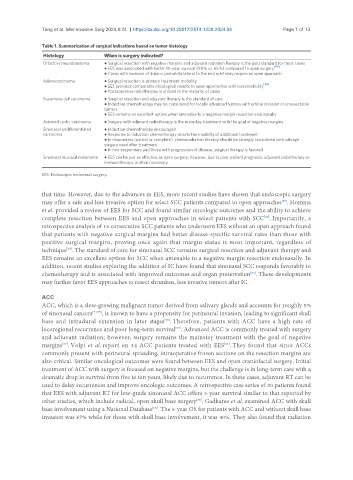
               Table 1. Summarization of surgical indications based on tumor histology
                Histology           When is surgery indicated?
                Olfactory neuroblastoma  ● Surgical resection with negative margins and adjuvant radiation therapy is the gold standard for most cases
                                    ● EES was associated with better 10-year survival (90% vs. 65%) compared to open surgery [44]
                                    ● Cases with invasion of dura or periorbita lateral to the mid orbit may require an open approach
                Adenocarcinoma      ● Surgical resection is primary treatment modality
                                                                                          [49]
                                    ● EES provides comparable oncological results to open approaches with less morbidity
                                    ● Postoperative radiotherpay is utilized in the majority of cases
                Squamous cell carcinoma  ● Surgical resection and adjuvant therapy is the standard of care
                                    ● Induction chemotherapy may be considered for locally advanced tumors with orbital invasion or unresectable
                                    tumors
                                    ● EES remains an excellent option when amenable to a negative margin resection endonasally
                Adenoid cystic carcinoma  ● Surgery with adjuvant radiotherapy is the mainstay treatment with the goal of negative margins
                Sinonasal undifferentiated   ● Induction chemotherapy encouraged
                carcinoma           ● Response to induction chemotherapy directs the modality of additional treatment
                                    ● In responders (partial or complete), chemoradiation therapy should be strongly considered with salvage
                                    surgery used after treatment
                                    ● In non-responders and those with progression of disease, surgical therapy is favored
                Sinonasal mucosal melanoma  ● EES can be just as effective as open surgery; however, due to poor patient prognosis, adjuvant radiotherapy or
                                    immunotherapy is often necessary
               EES: Endoscopic endonasal surgery.


               that time. However, due to the advances in EES, more recent studies have shown that endoscopic surgery
               may offer a safe and less invasive option for select SCC patients compared to open approaches . Homma
                                                                                                [36]
               et al. provided a review of EES for SCC and found similar oncologic outcomes and the ability to achieve
                                                                                          [52]
               complete resection between EES and open approaches in select patients with SCC . Importantly, a
               retrospective analysis of 15 consecutive SCC patients who underwent EES without an open approach found
               that patients with negative surgical margins had better disease-specific survival rates than those with
               positive surgical margins, proving once again that margin status is most important, regardless of
               technique . The standard of care for sinonasal SCC remains surgical resection and adjuvant therapy and
                       [37]
               EES remains an excellent option for SCC when amenable to a negative margin resection endonasally. In
               addition, recent studies exploring the addition of IC have found that sinonasal SCC responds favorably to
               chemotherapy and is associated with improved outcomes and organ preservation . These developments
                                                                                     [53]
               may further favor EES approaches to resect shrunken, less invasive tumors after IC.

               ACC
               ACC, which is a slow-growing malignant tumor derived from salivary glands and accounts for roughly 5%
               of sinonasal cancers [54,55] , is known to have a propensity for perineural invasion, leading to significant skull
               base and intradural extension in later stages . Therefore, patients with ACC have a high rate of
                                                        [56]
                                                            [57]
               locoregional recurrence and poor long-term survival . Advanced ACC is commonly treated with surgery
               and adjuvant radiation; however, surgery remains the mainstay treatment with the goal of negative
               margins . Volpi et al. report on 34 ACC patients treated with EES . They found that since ACCs
                                                                             [55]
                      [57]
               commonly present with perineural spreading, intraoperative frozen sections on the resection margins are
               also critical. Similar oncological outcomes were found between EES and open craniofacial surgery. Initial
               treatment of ACC with surgery is focused on negative margins, but the challenge is in long-term care with a
               dramatic drop in survival from five to ten years, likely due to recurrence. In these cases, adjuvant RT can be
               used to delay recurrences and improve oncologic outcomes. A retrospective case series of 30 patients found
               that EES with adjuvant RT for low-grade sinonasal ACC offers 5-year survival similar to that reported by
               other studies, which include radical, open skull base surgery . Gadkaree et al. examined ACC with skull
                                                                   [56]
               base involvement using a National Database . The 5-year OS for patients with ACC and without skull base
                                                    [58]
               invasion was 67% while for those with skull base involvement, it was 40%. They also found that radiation

