


Page 19 - Read Online
P. 19
Page 313                                                                                      Guerra et al. J Transl Genet Genom 2022;6:304-21      https://dx.doi.org/10.20517/jtgg.2022.08


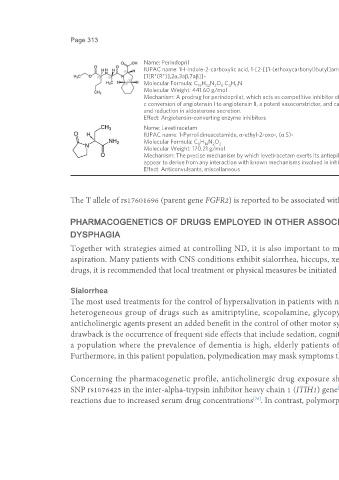
                                                    Name: Perindopril                                                                                         Mechanistic genes: SFRP4, ACE, AGT, AGTR1, MMP2, TGFB1
                                                    IUPAC name: 1H-Indole-2-carboxylic acid, 1-[2-[[1-(ethoxycarbonyl)butyl]amino]-1-oxopropyl]octahydro-, [2S-  Metabolic genes:
                                                    [1[R*(R*)],2α,3aβ,7aβ]]-                                                                                  Substate: BCHE
                                                    Molecular Formula: C H N O  C H N                                                                         Transporter genes: SLC15A1, SLC15A2
                                                                       19  32  2  5  4  11
                                                    Molecular Weight: 441.60 g/mol
                                                    Mechanism: A prodrug for perindoprilat, which acts as competitive inhibitor of angiotensin-converting enzyme. Prevents
                                                    c conversion of angiotensin I to angiotensin II, a potent vasoconstrictor, and causes an increase in plasma renin activity
                                                    and reduction in aldosterone secretion.
                                                    Effect: Angiotensin-converting enzyme inhibitors

                                                    Name: Levetiracetam                                                                                       Mechanistic genes: SV2A, CACNA1B, MT-TK
                                                    IUPAC name: 1-Pyrrolidineacetamide, α-ethyl-2-oxo-, (α S)-                                                Metabolic genes:
                                                    Molecular Formula: C H N O                                                                                Unknown: CYP2D6, CYP3A4
                                                                       8  14  2  2
                                                    Molecular Weight: 170.21 g/mol                                                                            Transporter genes: ABCB1
                                                    Mechanism: The precise mechanism by which levetiracetam exerts its antiepileptic effect is unknown and does not
                                                    appear to derive from any interaction with known mechanisms involved in inhibitory and excitatory neurotransmission.
                                                    Effect: Anticonvulsants, miscellaneous


                          The T allele of rs17601696 (parent gene FGFR2) is reported to be associated with ND .
                                                                                                                              [72]


                          PHARMACOGENETICS OF DRUGS EMPLOYED IN OTHER ASSOCIATED OROPHARYNGEAL SYMPTOMS IN NEUROGENIC

                          DYSPHAGIA
                          Together with strategies aimed at controlling ND, it is also important to manage those factors that may exacerbate symptoms and increase the risk of

                          aspiration. Many patients with CNS conditions exhibit sialorrhea, hiccups, xerostomia, or reflux with swallowing difficulties. Prior to considering systemic
                          drugs, it is recommended that local treatment or physical measures be initiated first [Table 4] .
                                                                                                                                        [37]


                          Sialorrhea
                          The most used treatments for the control of hypersalivation in patients with neurological damage are based on their anticholinergic profiles. This includes a
                          heterogeneous group of drugs such as amitriptyline, scopolamine, glycopyrronium chloride, trihexyphenidyl, atropine, or thiopium bromide. These

                                                                                                                                                                                          [73]
                          anticholinergic agents present an added benefit in the control of other motor symptoms, as occurs in patients with Parkinson’s disease . However, their main
                          drawback is the occurrence of frequent side effects that include sedation, cognitive deficits, constipation, urinary retention, tremor, and blurred vision. Within
                          a population where the prevalence of dementia is high, elderly patients often use drugs with anticholinergic effects, and frequently in combination.

                          Furthermore, in this patient population, polymedication may mask symptoms that are misdiagnosed as pathology unrelated to drug toxicity .
                                                                                                                                                                                               [74]


                          Concerning the pharmacogenetic profile, anticholinergic drug exposure shows associated variants located at chromosome 3p21.1 locus, with the top
                          SNP rs1076425 in the inter-alpha-trypsin inhibitor heavy chain 1 (ITIH1) gene . Subjects with CYP2D6/CYP2C19 PM phenotype increase the risk of adverse
                                                                                                                        [75]
                          reactions due to increased serum drug concentrations . In contrast, polymorphisms of the ARGEF10, ADRB3, ROCK2, and CYP3A4 genes in the cholinergic
                                                                                          [76]

