


Page 24 - Read Online
P. 24
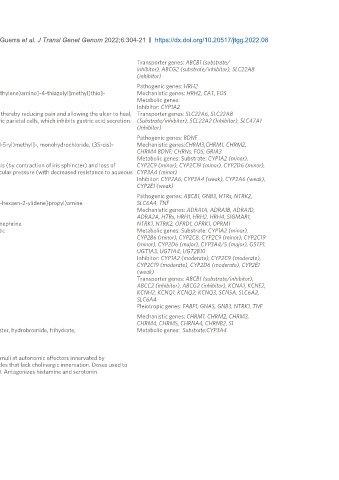
Page 315  Guerra et al. J Transl Genet Genom 2022;6:304-21  https://dx.doi.org/10.20517/jtgg.2022.08


                                                 Transporter genes: ABCB1 (substrate/
                                                 inhibitor), ABCG2 (substrate/inhibitor), SLC22A8
                                                 (inhibitor)
 Name: Famotidine                                Pathogenic genes: HRH2
 IUPAC name: Propanimidamide, N’-(aminosulfonyl)-3-[[[2-[(diaminomethylene)amino]-4-thiazolyl]methyl]thio]-   Mechanistic genes: HRH2, CAT, FOS
 Molecular formular: C H N O S                   Metabolic genes:
 8  15  7  2 3
 Molecular weight: 337.45 g/mol                  Inhibitor: CYP1A2
 Action: Famotidine works by reducing the amount of acid in the stomach, thereby reducing pain and allowing the ulcer to heal,  Transporter genes: SLC22A6, SLC22A8
 and through a competitive inhibition of histamine at H2 receptors of gastric parietal cells, which inhibits gastric acid secretion.   (Substrate/inhibitor), SCL22A2 (Inhibitor), SLC47A1
 Effect: Antiulcer agents and acid suppressants, histamine H2-antagonists  (Inhibitor)
 Name: Pilocarpine                               Pathogenic genes: BDNF
 IUPAC name:. 2(3H)-Furanone, 3-ethyldihydro-4-[(1-methyl-1H-imidazol-5-yl)methyl]-, monohydrochloride, (3S-cis)-    Mechanistic genes:CHRM3,CHRM1, CHRM2,
 Molecular Formula: C H N O                      CHRM4 BDNF; CHRNs; FOS; GRIA3
 11  16  2  2
 Molecular weight: 244.72 g/mol                  Metabolic genes: Substrate: CYP1A2 (minor),
 Mechanism: Directly stimulates cholinergic receptors in eye causing miosis (by contraction of iris sphincter) and loss of   CYP2C9 (minor), CYP2C19 (minor), CYP2D6 (minor),
 accommodation (by constriction of ciliary muscle) and lowering of intraocular pressure (with decreased resistance to aqueous  CYP3A4 (minor)
 humor outflow)                                  Inhibitor: CYP2A6, CYP3A4 (weak), CYP2A6 (weak),
 Effect: Antiglaucoma agents, miotics, cholinergic agonists  CYP2E1 (weak)
 Name: Amitriptyline                             Pathogenic genes: ABCB1, GNB3, HTRs, NTRK2,
 3 8
 IUPAC Name: dimethyl(3-{tricyclo[9.4.0.0 , ]pentadeca-1(15),3,5,7,11,13-hexaen-2-ylidene}propyl)amine   SLC6A4, TNF
 Molecular Formula: C H ClN                      Mechanistic genes: ADRA1A, ADRA1B, ADRA1D,
 24
 20
 Molecular Weight: 313.86426 g/mol               ADRA2A, HTRs, HRH1, HRH2, HRH4, SIGMAR1,
 Mechanism: Increases synaptic concentration of serotonin and/or norepinephrine   NTRK1, NTRK2, OPRD1, OPRK1, OPRM1
 in the central nervous system by inhibiting their reuptake in the presynaptic   Metabolic genes: Substrate: CYP1A2 (minor),
 neuronal membrane                               CYP2B6 (minor), CYP2C8, CYP2C9 (minor), CYP2C19
 Effect: Adrenergic uptake inhibition, antimigraine activity,   (minor), CYP2D6 (major), CYP3A4/5 (major), GSTP1,
 analgesic (nonnarcotic) activity, antidepressant action  UGT1A3, UGT1A4, UGT2B10
                                                 Inhibitor: CYP1A2 (moderate), CYP2C9 (moderate),
                                                 CYP2C19 (moderate), CYP2D6 (moderate), CYP2E1
                                                 (weak)
                                                 Transporter genes: ABCB1 (substrate/inhibitor),
                                                 ABCC2 (inhibitor), ABCG2 (inhibitor), KCNA1, KCNE2,
                                                 KCNH2, KCNQ1, KCNQ2, KCNQ3, SCN5A, SLC6A2,
                                                 SLC6A4
                                                 Pleiotropic genes: FABP1, GNAS, GNB3, NTRK1, TNF
 Name: Scopolamine                               Mechanistic genes: CHRM1, CHRM2, CHRM3,
 IUPAC Name: Benzeneacetic acid,                 CHRM4, CHRM5, CHRNA4, CHRNB2, SI
 α-(hydroxymethyl)-, 9-methyl-3-oxa-9-azatricyclo[3.3.1.02,4]non-7-yl ester, hydrobromide, trihydrate,   Metabolic genes:  Substrate:CYP3A4
 [7(S)-(1α,2β,4β,5α,7β)]-
 Molecular Formula: C H NO HBr H O
 17  21  4  3  2
 Molecular weight: 438.31 g/mol
 Mechanism: Competitively inhibits acetylcholine and other cholinergic stimuli at autonomic effectors innervated by
 postganglionic cholinergic nerves and, to a lesser extent, on smooth muscles that lack cholinergic innervation. Doses used to
 decrease gastric secretions likely to cause dryness of mouth (xerostomia). Antagonizes histamine and serotonin
 Effect: Anticholinergic agents, antimuscarinics/antispasmodics

