


Page 26 - Read Online
P. 26
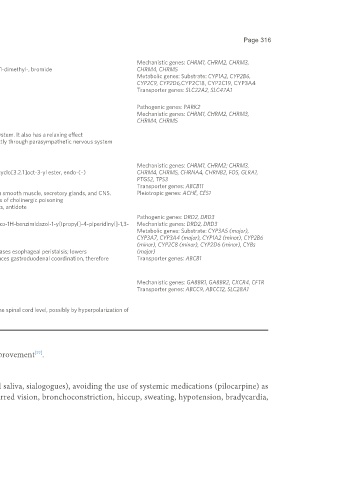
Guerra et al. J Transl Genet Genom 2022;6:304-21  https://dx.doi.org/10.20517/jtgg.2022.08  Page 316


 Name: Glycopyrrolate                            Mechanistic genes: CHRM1, CHRM2, CHRM3,
 IUPAC Name: Pyrrolidinium, 3-[(cyclopentylhydroxyphenylacetyl)oxy]-1,1-dimethyl-, bromide   CHRM4, CHRM5
 Molecular Formula: C H BrNO  Molecular Weight: 398.33 g/mol   Metabolic genes: Substrate: CYP1A2, CYP2B6,
 19  28  3
 Mechanism: Blocks action of acetylcholine at parasympathetic    CYP2C9, CYP2D6,CYP2C18, CYP2C19, CYP3A4
 sites in smooth muscle, secretory glands, and CNS   Transporter genes: SLC22A2, SLC47A1
 Effect: Anticholinergic agents, antimuscarinics/antispasmodics
 Name: Trihexyphenidyl                           Pathogenic genes: PARK2
 IUPAC Name: 1-Piperidinepropanol,α-cyclohexyl-α-phenyl   Mechanistic genes: CHRM1, CHRM2, CHRM3,
 Molecular Formula: C H NO                       CHRM4, CHRM5
 20  31
 Molecular Weight: 301,46 g/mol
 Mechanism: Exerts direct inhibitory effect on parasympathetic nervous system. It also has a relaxing effect
 on smooth musculature, exerted both directly on muscle itself and indirectly through parasympathetic nervous system
 (inhibitory effect)
 Effect: Antiparkinsonian agents, anticholinergic agents
 Name: Atropine                                  Mechanistic genes: CHRM1, CHRM2; CHRM3,
 IUPAC Name: Benzeneacetic acid, α-(hydroxymethyl)-8-methyl-8-azabicyclo[3.2.1]oct-3-yl ester, endo-(–)   CHRM4, CHRM5, CHRNA4, CHRNB2, FOS, GLRA1,
 Molecular Formula: C H NO                       PTGS2, TP53
 17  23  3
 Molecular Weight: 289.37 g/mol                  Transporter genes: ABCB11
 Mechanism: Blocks the action of acetylcholine at parasympathetic sites in smooth muscle, secretory glands, and CNS.   Pleiotropic genes: ACHE, CES1
 Increases cardiac output, dries secretions. Reverses the muscarinic effects of cholinergic poisoning
 Effect: Mydriatics, anticholinergic agents, antimuscarinics/antispasmodics, antidote
 Name: Domperidone                               Pathogenic genes: DRD2, DRD3
 IUPAC name: 2H-Benzimidazol-2-one, 5-chloro-1-[1-[3-(2,3-dihydro-2-oxo-1H-benzimidazol-1-yl)propyl]-4-piperidinyl]-1,3-  Mechanistic genes: DRD2, DRD3
 dihydro-                                        Metabolic genes: Substrate: CYP3A5 (major),
 Molecular Formula: C  H ClN O                   CYP3A7, CYP3A4 (major), CYP1A2 (minor), CYP2B6
 22  24  5  2
 Molecular weight: 425.91 g/mol                  (minor), CYP2C8 (minor), CYP2D6 (minor), CYBs
 Mechanism: Has peripheral dopamine receptor blocking properties. Increases esophageal peristalsis; lowers   (major)
 esophageal sphincter pressure, gastric motility, and peristalsis; and enhances gastroduodenal coordination, therefore   Transporter genes: ABCB1
 facilitating gastric emptying and decreasing small bowel transit time
 Effect: Prokinetic agents, dopamine antagonist
 Name: Baclofen                                  Mechanistic genes: GABBR1, GABBR2, CXCR4, CFTR
 IUPAC name: Butanoic acid, 4-amino-3-(4-chlorophenyl)-   Transporter genes: ABCC9, ABCC12, SLC28A1
 Molecular Formula: C H ClNO
 10
 12
 Molecular weight: 213.66 g/mol
 Mechanism: Inhibits the transmission of mono/polysynaptic reflexes at the spinal cord level, possibly by hyperpolarization of
 primary afferent fiber terminals
 Effect: GABA-derivative skeletal muscle relaxants


             [77]
 pathway do not appear to significantly modify parameters related to clinical improvement .


 Xerostomia
 The first line of treatment for xerostomia is to employ local therapies (artificial saliva, sialogogues), avoiding the use of systemic medications (pilocarpine) as
 the first choices due to their common negative effects. Side effects include blurred vision, bronchoconstriction, hiccup, sweating, hypotension, bradycardia,

