


Page 39 - Read Online
P. 39
Qu et al. J Transl Genet Genom 2023;7:3-16  https://dx.doi.org/10.20517/jtgg.2022.16  Page 9


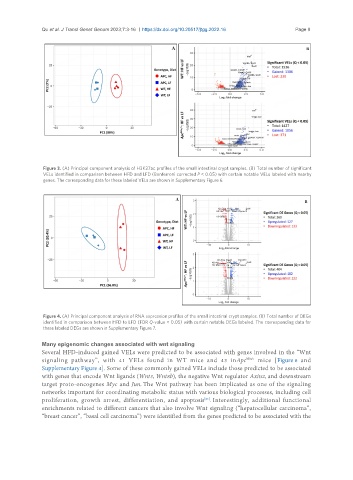
                Figure 3. (A) Principal component analysis of H3K27ac profiles of the small intestinal crypt samples. (B) Total number of significant
                VELs identified in comparison between HFD and LFD (Bonferroni corrected P < 0.05) with certain notable VELs labeled with nearby
                genes. The corresponding data for these labeled VELs are shown in Supplementary Figure 6.


                Figure 4. (A) Principal component analysis of RNA expression profiles of the small intestinal crypt samples. (B) Total number of DEGs
                identified in comparison between HFD to LFD (FDR Q-value < 0.05) with certain notable DEGs labeled. The corresponding data for
                these labeled DEGs are shown in Supplementary Figure 7.

               Many epigenomic changes associated with wnt signaling
               Several HFD-induced gained VELs were predicted to be associated with genes involved in the “Wnt
               signaling  pathway”,  with  41  VELs  found  in  WT  mice  and  43  inApc Min/+   mice  [Figure 6  and
               Supplementary Figure 4]. Some of these commonly gained VELs include those predicted to be associated
               with genes that encode Wnt ligands (Wnt3, Wnt8b), the negative Wnt regulator Axin2, and downstream
               target proto-oncogenes Myc and Jun. The Wnt pathway has been implicated as one of the signaling
               networks important for coordinating metabolic status with various biological processes, including cell
                                                                      [26]
               proliferation,  growth  arrest,  differentiation,  and  apoptosis . Interestingly,  additional  functional
               enrichments related to different cancers that also involve Wnt signaling (“hepatocellular carcinoma”,
               “breast cancer”, “basal cell carcinoma”) were identified from the genes predicted to be associated with the

