


Page 24 - Read Online
P. 24
Puyana et al. J Transl Genet Genom 2022;6:223-239  https://dx.doi.org/10.20517/jtgg.2021.51  Page 231

               Table 6. Association between CPR and obesity PRS
                                                           CRP (mg/L)               OR (95%CI)
                Obesity PRS levels 2           Below median 1       Above median 1
                                           n        %          n         %
                1                          60       59%        41        41%        Reference
                2                          50       50%        51        50%        1.49 (0.86 - 2.60)
                3                          51       50%        50        50%        1.44 (0.82 - 2.50)
                4                          43       43%        57        57%        1.94 (1.11 - 3.40)
               1                                 2
                Below median CRP ≤ 3.57, above median CRP > 3.57.  PRS level 1: PRS ≤ 34.3; level 2: 34.3 < PRS ≤ 39.8; level 3: 39.8 < PRS ≤ 47.18; level 4: PRS >
               47.18. CRP: C-reactive protein; PRS: polygenic risk score.

               Table 7. Bariatric surgery eligibility by PRS level and race/ethnicity
                                                        Bariatric surgery eligibility
                Variable                          Eligible              Not eligible      P-value 3
                                          n          %          n            %
                Total                     25         6          378          94
                PRS level 1
                1                         0          0          101          100          < 0.0001
                2                         2          2          99           98
                3                         9          9          92           91
                4                         14         14         86           86
                Race/ethnicity 2
                AA                        10         12         76           88           0.0504
                HW                        14         5          248          95
                NHW                       1          2          54           98
               1                                                             2
                PRS level 1: PRS ≤ 34.3; level 2: 34.3 < PRS ≤ 39.8; level 3: 39.8 < PRS ≤ 47.18; level 4: PRS > 47.18.  AA: African American; HW: Hispanic White;
                                 3
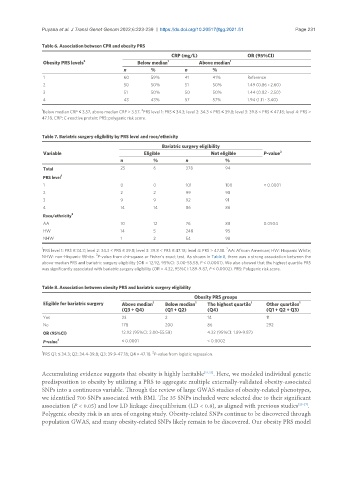
               NHW: non-Hispanic White.  P-value from chi-square or Fisher’s exact test. As shown in Table 8, there was a strong association between the
               above-median PRS and bariatric surgery eligibility (OR = 12.92, 95%CI: 3.00-55.58, P < 0.0001). We also showed that the highest quartile PRS
               was significantly associated with bariatric surgery eligibility (OR = 4.32, 95%CI: 1.89-9.87, P < 0.0002). PRS: Polygenic risk score.

               Table 8. Association between obesity PRS and bariatric surgery eligibility
                                                                   Obesity PRS groups
                Eligible for bariatric surgery  Above median   1  Below median   1  The highest quartile   1  Other quartiles   1
                                          (Q3 + Q4)      (Q1 + Q2)     (Q4)                (Q1 + Q2 + Q3)
                Yes                       23             2             14                  11
                No                        178            200           86                  292
                OR (95%CI)                12.92 (95%CI: 3.00-55.58)    4.32 (95%CI: 1.89-9.87)
                P-value 2                 < 0.0001                     < 0.0002

               1                                    2
                PRS Q1: ≤ 34.3; Q2: 34.4-39.8; Q3: 39.9-47.18; Q4 > 47.18.  P-value from logistic regression.

               Accumulating evidence suggests that obesity is highly heritable [21,23] . Here, we modeled individual genetic
               predisposition to obesity by utilizing a PRS to aggregate multiple externally-validated obesity-associated
               SNPs into a continuous variable. Through the review of large GWAS studies of obesity-related phenotypes,
               we identified 700 SNPs associated with BMI. The 35 SNPs included were selected due to their significant
               association (P < 0.05) and low LD linkage disequilibrium (LD < 0.8), as aligned with previous studies [25-27] .
               Polygenic obesity risk is an area of ongoing study. Obesity-related SNPs continue to be discovered through
               population GWAS, and many obesity-related SNPs likely remain to be discovered. Our obesity PRS model

