


Page 22 - Read Online
P. 22
Puyana et al. J Transl Genet Genom 2022;6:223-239  https://dx.doi.org/10.20517/jtgg.2021.51  Page 229

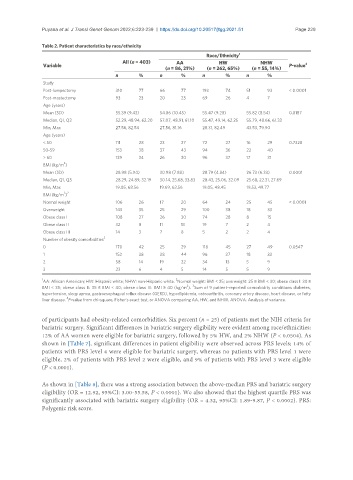
               Table 2. Patient characteristics by race/ethnicity
                                                                       Race/Ethnicity 1
                                          All (n = 403)     AA             HW            NHW
                Variable                                                                          P-value 4
                                                         (n = 86, 21%)  (n = 262, 65%)  (n = 55, 14%)
                                        n       %      n      %      n       %      n      %
                Study
                Post-lumpectomy         310     77     66     77     193     74     51     93     < 0.0001
                Post-mastectomy         93      23     20     23     69      26     4      7
                Age (years)
                Mean (SD)               55.39 (9.43)   54.86 (10.45)  55.47 (9.28)  55.82 (8.54)  0.8187
                Median, Q1, Q3          52.29, 48.94, 62.20  57.07, 48.91, 61.10  55.47, 49.14, 62.25  55.79, 48.66, 61.33
                Min, Max                27.56, 82.54   27.56, 81.16  28.31, 82.49   43.53, 79.90
                Age (years)
                < 50                    111     28     23     27     72      27     16     29     0.7328
                50-59                   153     38     37     43     94      36     22     40
                > 60                    139     34     26     30     96      37     17     31
                       2
                BMI (kg/m )
                Mean (SD)               28.98 (5.94)   30.98 (7.88)  28.79 (4.84)   26.73 (6.33)  0.0001
                Median, Q1, Q3          28.29, 24.89, 32.19  30.14, 25.68, 33.83  28.43, 25.06, 32.09  25.68, 22.31, 27.69
                Min, Max                19.05, 68.56   19.69, 63.56  19.05, 48.45   19.53, 49.77
                       2 2
                BMI (kg/m )
                Normal weight           106     26     17     20     64      24     25     45     < 0.0001
                Overweight              143     35     25     29     100     38     18     33
                Obese class I           108     27     26     30     74      28     8      15
                Obese class II          32      8      11     13     19      7      2      4
                Obese class III         14      3      7      8      5       2      2      4
                                    3
                Number of obesity comorbidities
                0                       170     42     25     29     118     45     27     49     0.0547
                1                       152     38     38     44     96      37     18     33
                2                       58      14     19     22     34      13     5      9
                3                       23      6      4      5      14      5      5      9
               1                                            2
                AA: African American; HW: Hispanic white; NHW: non-Hispanic white.  Normal weight: BMI < 25; overweight: 25 ≤ BMI < 30; obese class I: 30 ≤
                                                                2  3
               BMI < 35; obese class II: 35 ≤ BMI < 40; obese class III: BMI ≥ 40 (kg/m ).  Sum of 9 patient-reported comorbidity conditions diabetes,
               hypertension, sleep apnea, gastroesophageal reflux disease (GERD), hyperlipidemia, osteoarthritis, coronary artery disease, heart disease, or fatty
                       4
               liver disease.  P-value from chi-square, Fisher’s exact test, or ANOVA comparing AA, HW, and NHW. ANOVA: Analysis of variance.
               of participants had obesity-related comorbidities. Six percent (n = 25) of patients met the NIH criteria for
               bariatric surgery. Significant differences in bariatric surgery eligibility were evident among race/ethnicities:
               12% of AA women were eligible for bariatric surgery, followed by 5% HW, and 2% NHW (P < 0.0504). As
               shown in [Table 7], significant differences in patient eligibility were observed across PRS levels; 14% of
               patients with PRS level 4 were eligible for bariatric surgery, whereas no patients with PRS level 1 were
               eligible, 2% of patients with PRS level 2 were eligible, and 9% of patients with PRS level 3 were eligible
               (P < 0.0001).


               As shown in [Table 8], there was a strong association between the above-median PRS and bariatric surgery
               eligibility (OR = 12.92, 95%CI: 3.00-55.58, P < 0.0001). We also showed that the highest quartile PRS was
               significantly associated with bariatric surgery eligibility (OR = 4.32, 95%CI: 1.89-9.87, P < 0.0002). PRS:
               Polygenic risk score.

