


Page 23 - Read Online
P. 23
Page 230               Puyana et al. J Transl Genet Genom 2022;6:223-239  https://dx.doi.org/10.20517/jtgg.2021.51

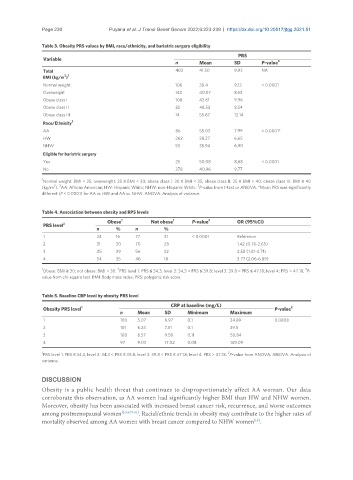
               Table 3. Obesity PRS values by BMI, race/ethnicity, and bariatric surgery eligibility
                                                                                 PRS
                Variable
                                                            n       Mean        SD       P-value 3
                Total                                       403     41.50       9.93     NA
                       2 1
                BMI (kg/m )
                Normal weight                               106     38.4        9.13     < 0.0001
                Overweight                                  143     40.07       8.53
                Obese class I                               108     42.61       9.96
                Obese class II                              32      48.53       8.54
                Obese class III                             14      55.67       12.14
                Race/Ethnicity 2
                AA                                          86      55.03       7.99     < 0.0001*
                HW                                          262     38.27       6.65
                NHW                                         55      35.94       6.90
                Eligible for bariatric surgery
                Yes                                         25      50.08       8.68     < 0.0001
                No                                          378     40.96       9.77

               1
                Normal weight: BMI < 25; overweight: 25 ≤ BMI < 30; obese class I: 30 ≤ BMI < 35; obese class II: 35 ≤ BMI < 40; obese class III: BMI ≥ 40
                   2  2                                             3
               (kg/m ).  AA: African American; HW: Hispanic White; NHW: non-Hispanic White.  P-value from t-test or ANOVA. *Mean PRS was significantly
               different (P < 0.0001) for AA vs. HW and AA vs. NHW. ANOVA: Analysis of variance.
               Table 4. Association between obesity and RPS levels
                                     Obese 1        Not obese 1   P-value 3      OR (95%CI)
                PRS level 2
                                  n     %      n        %
                1                 24    16     77       31        < 0.0001       Reference
                2                 31    20     70       28                       1.42 (0.76-2.65)
                3                 45    29     56       22                       2.58 (1.41-4.71)
                4                 54    35     46       18                       3.77 (2.06-6.89)
               1                         2                                                              3
                Obese: BMI ≥ 30; not obese: BMI < 30.  PRS level 1: PRS ≤ 34.3; level 2: 34.3 < PRS ≤ 39.8; level 3: 39.8 < PRS ≤ 47.18; level 4: PRS > 47.18.  P-
               value from chi-square test. BMI: Body mass index; PRS: polygenic risk score.


               Table 5. Baseline CRP level by obesity PRS level
                                                           CRP at baseline (mg/L)
                Obesity PRS level 1                                                           P-value 2
                                          n    Mean      SD     Minimum        Maximum
                1                         100  5.07      6.97   0.1            34.89          0.0808
                2                         101  6.23      7.51   0.1            39.5
                3                         100  6.57      9.58   0.11           50.84
                4                         97   9.03      17.02  0.08           149.09
               1                                                              2
                PRS level 1: PRS ≤ 34.3; level 2: 34.3 < PRS ≤ 39.8; level 3: 39.8 < PRS ≤ 47.18; level 4: PRS > 47.18.  P-value from ANOVA. ANOVA: Analysis of
               variance.

               DISCUSSION
               Obesity is a public health threat that continues to disproportionately affect AA woman. Our data
               corroborate this observation, as AA women had significantly higher BMI than HW and NHW women.
               Moreover, obesity has been associated with increased breast cancer risk, recurrence, and worse outcomes
               among postmenopausal women [2,3,8,77-81] . Racial/ethnic trends in obesity may contribute to the higher rates of
               mortality observed among AA women with breast cancer compared to NHW women .
                                                                                       [18]

