


Page 42 - Read Online
P. 42
Li et al. J. Mater. Inf. 2025, 5, 21  https://dx.doi.org/10.20517/jmi.2024.87    Page 7 of 15

               Table 1. 13 most promising K-/P-containing compounds after GT and BVSE analysis
                                                                                    2
                Formula ICSD code  Space group  Migration map (GT/BVSE)  E m  σ (S·cm )  D (cm ·s )  C  (mAh/g)  E  (eV)
                                                                            -1
                                                                                      -1
                                                                                          g
                                                                                                    g
                K AuP  300201    Cmcm       3/3                   0.45 7.01 × 10 -9  6.29 × 10 -14  175.12  0.95
                2
                                                                            -9       -14
                K CuP  61082     Cmcm       3/3                   0.68 1.38 × 10  1.18 × 10  310.41  1.14
                2
                                                                             -9      -14
                K Cu P  12163    R3m        3/3                   0.73  2.47 × 10  1.89 × 10  217.42  1.29
                   3 2
                3
                KMnP   89593     P4/nmm     2/2                   0.45 2.34 × 10 -11  5.25 × 10 -16  214.43  0
                                                                             -16     -21
                K CdP  61084     C2/m       3/2                   0.32  2.77 × 10  2.81 × 10  324.18  0.82
                4   2
                                                                            -3       -8    *
                K InP 2  300141  Ibam       3/3                   0.48 1.06 × 10  1.08 × 10  SE     0.79
                3
                K AlP 2  300130  P1         3/3                   0.58 1.01 × 10 -5  6.61 × 10 -11  SE  0.70
                3
                                                                             -6      -11
                K InP  300147    P1         3/3                   0.40 4.50 × 10  3.41 × 10  SE     0.75
                6  3
                K P    25550     P6 /mmc    3/3                   0.21  1.24 × 10 -6  9.67 × 10 -12  SE  0.21
                                  3
                3
                                                                             -7      -12
                K P    64625     Cmcm       3/3                   0.77 7.33 × 10  6.18 × 10  SE     0
                4 3
                                                                             -8       -13
                KP     14010     P2 2 2     3/3                    0.39 3.01 × 10  2.72 × 10  SE    1.03
                                  1 1 1
                K BeP 2  300110  R3m        3/3                    0.57  7.63 × 10 -8  6.04 × 10 -13  SE  1.14
                4
                                                                             -8       -13
                K BP   300104    C2/c       3/3                    0.87 3.89 × 10  3.67 × 10  SE    1.67
                3  2
               *
                Potential base for solid electrolytes. GT: Geometrical-topological; BVSE: bond valence site energy.


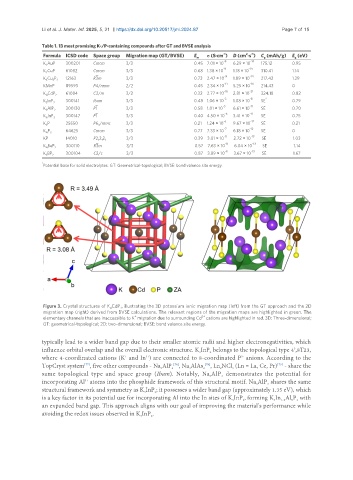
                Figure 3. Crystal structures of K CdP , illustrating the 3D potassium ionic migration map (left) from the GT approach and the 2D
                                      4
                                          2
                migration map (right) derived from BVSE calculations. The relevant regions of the migration maps are highlighted in green. The
                                              +
                                                                     2+
                elementary channels that are inaccessible to K  migration due to surrounding Cd  cations are highlighted in red. 3D: Three-dimensional;
                GT: geometrical-topological; 2D: two-dimensional; BVSE: bond valence site energy.
               typically lead to a wider band gap due to their smaller atomic radii and higher electronegativities, which
               influence orbital overlap and the overall electronic structure. K InP  belongs to the topological type 4 ,8T23,
                                                                                                    3
                                                                    3
                                                                        2
                                                  3+
                                           +
                                                                                  3-
               where 4-coordinated cations (K  and In ) are connected to 8-coordinated P  anions. According to the
                                                                      [78]
                                                                                              [79]
                                                           [78]
                             [77]
               TopCryst system , five other compounds - Na AlP , Na AlAs , Ln NCl  (Ln = La, Ce, Pr)  - share the
                                                                           2
                                                           2
                                                       3
                                                                 3
                                                                               3
                                                                      2
               same topological type and space group (Ibam). Notably, Na AlP  demonstrates the potential for
                                                                        3
                                                                            2
                              3+
               incorporating Al  atoms into the phosphide framework of this structural motif. Na AlP  shares the same
                                                                                           2
                                                                                       3
               structural framework and symmetry as K InP ; it possesses a wider band gap (approximately 1.35 eV), which
                                                     2
                                                  3
               is a key factor in its potential use for incorporating Al into the In sites of K InP , forming K In Al P  with
                                                                                                1-x
                                                                                                   x 2
                                                                               3
                                                                                             3
                                                                                   2
               an expanded band gap. This approach aligns with our goal of improving the material’s performance while
               avoiding the redox issues observed in K InP .
                                                3
                                                    2

