


Page 39 - Read Online
P. 39
Page 4 of 15                          Li et al. J. Mater. Inf. 2025, 5, 21  https://dx.doi.org/10.20517/jmi.2024.87

               principle of maintaining local bond strength equilibrium, which is essential for understanding ion
               movement within a crystal lattice. By considering the Coulombic repulsion between the migrating ion and
                                                                                           [51]
               the ions in the crystal framework, the migration energy barriers for the ions are calculated . The migration
                                    +
               energy landscape for K  was computed using a Cube.file with a resolution of 0.1 and an automatically
               determined screening factor (f) .
                                         [52]
               To evaluate the dimensionality of the migration map, we determined the migration barrier energy (E ). The
                                                                                                    m
               most promising candidates for KMC simulations and DFT calculations were selected based on the criterion
               that E  < 1 eV and the material should exhibit 2D or 3D ionic conductivity. This criterion is important
                    m
               because, although 1D ionic conductors can exhibit high conductivity under certain conditions, their
               sensitivity to defects and interfaces limits their practical applications.


               KMC simulations
               Ionic conductivities and diffusion coefficients were calculated using KMC simulations. For this purpose,
                                                     3
               supercells with volumes exceeding 10,000 Å  were simulated for 1 to 10 million KMC steps at 300 K. The
               KMC algorithm, implemented in the command-line version of softBV, utilizes approximate site and
               migration energies derived from BVSE analysis. The results were averaged over five different configurations
               to ensure statistical reliability. The unit cells were relaxed using the softBV force field. The ionic diffusion
               coefficient is a key performance indicator for cathode materials. Compounds with high ionic diffusion
               coefficients are characterized by continuous ion transport channels and low migration barriers [53,54] .


               DFT calculations
               All  DFT  calculations   were  performed  using  the  projected  augmented  wave  (PAW)  method ,
                                                                                                       [56]
                                  [55]
               implemented in the Vienna Ab initio Simulation Package (VASP) [57,58] . The Perdew-Burke-Ernzerhof (PBE)
               functional in the generalized gradient approximation (GGA)  was used to describe the exchange-
                                                                       [59]
               correlation interactions. Structural optimization was carried out using the conjugate gradient method, with
                                        -5
               convergence thresholds of 10  eV for energy and 0.03 eV/Å for interatomic forces. A plane-wave energy
               cutoff of 520 eV was employed. To correct the self-interaction error and account for strong correlation
               effects in localized electrons, Hubbard U corrections were applied, with a U value of 5.2 eV for Cu . The
                                                                                                    [60]
               Ewald summation method  was used to screen the system during the K-ion charging process, leading to
                                      [61]
               the generation of various configurations.

               The formation energy diagram was constructed to identify the configuration with the lowest energy at
               different optimized concentrations. Stable intermediate phases were identified as those on the convex hull,
               while other compounds were classified as metastable or unstable. The energy above the hull (E ) for stable
                                                                                               hull
               intermediate phases was calculated, and the maximum potassium removal capacity was determined for
               those phases with E  < 0.1 eV/atom, providing the reversible capacity of the candidate cathode materials.
                                hull
               Ionic migration barriers for K  ions were calculated using the nudged elastic band (NEB) method , with
                                                                                                   [62]
                                         +
               input files generated via the PATHFINDER script (https://pathfinder.batterymaterials.info).
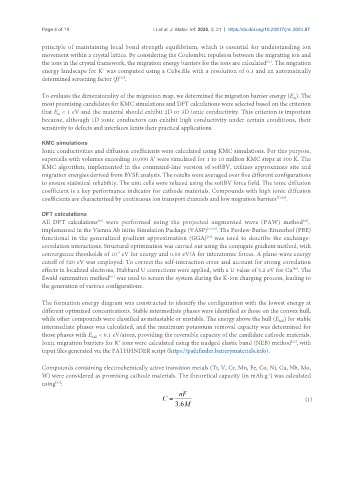
               Compounds containing electrochemically active transition metals (Ti, V, Cr, Mn, Fe, Co, Ni, Cu, Nb, Mo,
                                                                                           -1
               W) were considered as promising cathode materials. The theoretical capacity (in mAh·g ) was calculated
               using :
                    [63]
                                                                                                        (1)

