


Page 41 - Read Online
P. 41
Page 6 of 15                          Li et al. J. Mater. Inf. 2025, 5, 21  https://dx.doi.org/10.20517/jmi.2024.87


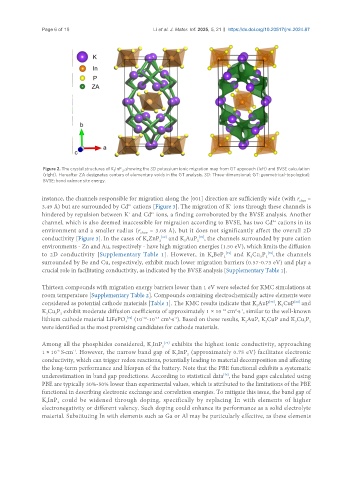
                Figure 2. The crystal structures of K InP , showing the 3D potassium ionic migration map from GT approach (left) and BVSE calculation
                                       3
                                          2
                (right). Hereafter ZA designates centers of elementary voids in the GT analysis. 3D: Three-dimensional; GT: geometrical-topological;
                BVSE: bond valence site energy.
               instance, the channels responsible for migration along the [001] direction are sufficiently wide (with r  =
                                                                                                      chan
                                                                               +
               3.49 Å) but are surrounded by Cd  cations [Figure 3]. The migration of K  ions through these channels is
                                            2+
               hindered by repulsion between K  and Cd  ions, a finding corroborated by the BVSE analysis. Another
                                            +
                                                    2+
                                                                                             2+
               channel, which is also deemed inaccessible for migration according to BVSE, has two Cd  cations in its
               environment and a smaller radius (r  = 3.08 Å), but it does not significantly affect the overall 2D
                                                chan
               conductivity [Figure 3]. In the cases of K ZnP  and K AuP , the channels surrounded by pure cation
                                                                    [70]
                                                       [69]
                                                   4
                                                                   2
                                                       2
                                                               5
               environments - Zn and Au, respectively - have high migration energies (1.50 eV), which limits the diffusion
               to 2D conductivity [Supplementary Table 1]. However, in K BeP 2 [71]  and K Cu P  [72] , the channels
                                                                                      3
                                                                                         3 2
                                                                        4
               surrounded by Be and Cu, respectively, exhibit much lower migration barriers (0.57-0.73 eV) and play a
               crucial role in facilitating conductivity, as indicated by the BVSE analysis [Supplementary Table 1].
               Thirteen compounds with migration energy barriers lower than 1 eV were selected for KMC simulations at
               room temperature [Supplementary Table 2]. Compounds containing electrochemically active elements were
                                                                                            [73]
               considered as potential cathode materials [Table 1]. The KMC results indicate that K AuP , K CuP  and
                                                                                                    [68]
                                                                                       2
                                                                                                2
               K Cu P  exhibit moderate diffusion coefficients of approximately 1 × 10  cm ·s , similar to the well-known
                                                                                2 -1
                                                                            -14
                 3
                    3 2
                                                          2 -1
                                                     -15
                                            [74]
               lithium cathode material LiFePO  (10 -10  cm ·s ). Based on these results, K AuP, K CuP and K Cu P
                                                 -14
                                                                                    2
                                                                                                        3 2
                                                                                                    3
                                                                                          2
                                           4
               were identified as the most promising candidates for cathode materials.
               Among all the phosphides considered, K InP  exhibits the highest ionic conductivity, approaching
                                                        [75]
                                                    3
                                                        2
               1 × 10  S·cm . However, the narrow band gap of K InP  (approximately 0.75 eV) facilitates electronic
                          -1
                    -3
                                                            3
                                                                2
               conductivity, which can trigger redox reactions, potentially leading to material decomposition and affecting
               the long-term performance and lifespan of the battery. Note that the PBE functional exhibits a systematic
               underestimation in band gap predictions. According to statistical data , the band gaps calculated using
                                                                            [76]
               PBE are typically 30%-50% lower than experimental values, which is attributed to the limitations of the PBE
               functional in describing electronic exchange and correlation energies. To mitigate this issue, the band gap of
               K InP   could  be  widened  through  doping,  specifically  by  replacing  In  with  elements  of  higher
                 3
                    2
               electronegativity or different valency. Such doping could enhance its performance as a solid electrolyte
               material. Substituting In with elements such as Ga or Al may be particularly effective, as these elements

