


Page 45 - Read Online
P. 45
Page 10 of 15                         Li et al. J. Mater. Inf. 2025, 5, 21  https://dx.doi.org/10.20517/jmi.2024.87


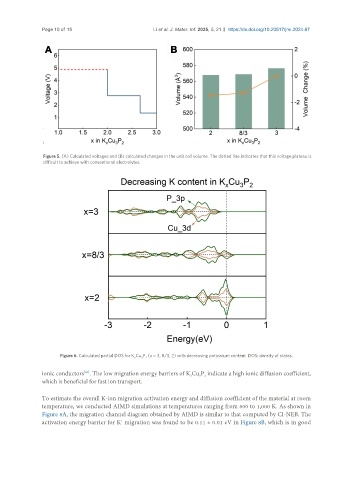
                Figure 5. (A) Calculated voltages and (B) calculated changes in the unit cell volume. The dotted line indicates that this voltage plateau is
                difficult to achieve with conventional electrolytes.


                     Figure 6. Calculated partial DOS for K Cu P  (x = 3, 8/3, 2) with decreasing potassium content. DOS: density of states.
                                              x  3 2

               ionic conductors . The low migration energy barriers of K Cu P  indicate a high ionic diffusion coefficient,
                             [41]
                                                                    3 2
                                                                 3
               which is beneficial for fast ion transport.
               To estimate the overall K-ion migration activation energy and diffusion coefficient of the material at room
               temperature, we conducted AIMD simulations at temperatures ranging from 600 to 1,000 K. As shown in
               Figure 8A, the migration channel diagram obtained by AIMD is similar to that computed by CI-NEB. The
               activation energy barrier for K  migration was found to be 0.11 ± 0.01 eV in Figure 8B, which is in good
                                          +

