


Page 21 - Read Online
P. 21
Page 14 of 28                        Zhang et al. J Mater Inf 2024;4:34  https://dx.doi.org/10.20517/jmi.2024.64


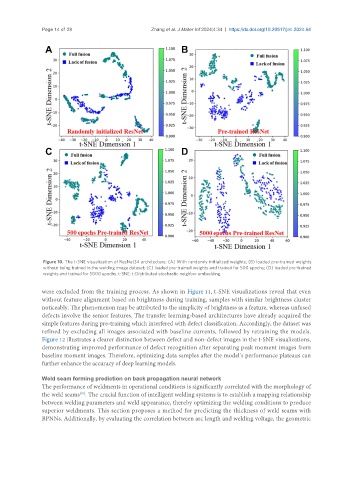
                Figure 10. The t-SNE visualization of ResNet34 architecture. (A) With randomly initialized weights; (B) loaded pre-trained weights
                without being trained in the welding image dataset; (C) loaded pre-trained weights and trained for 500 epochs; (D) loaded pre-trained
                weights and trained for 5000 epochs. t-SNE: t-Distributed stochastic neighbor embedding.

               were excluded from the training process. As shown in Figure 11, t-SNE visualizations reveal that even
               without feature alignment based on brightness during training, samples with similar brightness cluster
               noticeably. The phenomenon may be attributed to the simplicity of brightness as a feature, whereas unfused
               defects involve the senior features. The transfer learning-based architectures have already acquired the
               simple features during pre-training which interfered with defect classification. Accordingly, the dataset was
               refined by excluding all images associated with baseline currents, followed by retraining the models.
               Figure 12 illustrates a clearer distinction between defect and non-defect images in the t-SNE visualizations,
               demonstrating improved performance of defect recognition after separating peak moment images from
               baseline moment images. Therefore, optimizing data samples after the model’s performance plateaus can
               further enhance the accuracy of deep learning models.

               Weld seam forming prediction on back propagation neural network
               The performance of weldments in operational conditions is significantly correlated with the morphology of
                            [93]
               the weld seams . The crucial function of intelligent welding systems is to establish a mapping relationship
               between welding parameters and weld appearance, thereby optimizing the welding conditions to produce
               superior weldments. This section proposes a method for predicting the thickness of weld seams with
               BPNNs. Additionally, by evaluating the correlation between arc length and welding voltage, the geometric

