


Page 19 - Read Online
P. 19
Page 12 of 28                        Zhang et al. J Mater Inf 2024;4:34  https://dx.doi.org/10.20517/jmi.2024.64


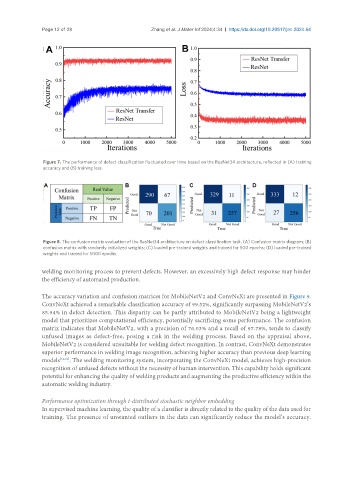
                Figure 7. The performance of defect classification fluctuated over time based on the ResNet34 architecture, reflected in (A) training
                accuracy and (B) training loss.


                Figure 8. The confusion matrix evaluation of the ResNet34 architecture on defect classification task. (A) Confusion matrix diagram; (B)
                confusion matrix with randomly initialized weights; (C) loaded pre-trained weights and trained for 500 epochs; (D) loaded pre-trained
                weights and trained for 5000 epochs.

               welding monitoring process to prevent defects. However, an excessively high defect response may hinder
               the efficiency of automated production.


               The accuracy variation and confusion matrices for MobileNetV2 and ConvNeXt are presented in Figure 9.
               ConvNeXt achieved a remarkable classification accuracy of 99.52%, significantly surpassing MobileNetV2’s
               85.94% in defect detection. This disparity can be partly attributed to MobileNetV2 being a lightweight
               model that prioritizes computational efficiency, potentially sacrificing some performance. The confusion
               matrix indicates that MobileNetV2, with a precision of 76.03% and a recall of 97.78%, tends to classify
               unfused images as defect-free, posing a risk in the welding process. Based on the appraisal above,
               MobileNetV2 is considered unsuitable for welding defect recognition. In contrast, ConvNeXt demonstrates
               superior performance in welding image recognition, achieving higher accuracy than previous deep learning
               models [12,21] . The welding monitoring system, incorporating the ConvNeXt model, achieves high-precision
               recognition of unfused defects without the necessity of human intervention. This capability holds significant
               potential for enhancing the quality of welding products and augmenting the productive efficiency within the
               automatic welding industry.


               Performance optimization through t-distributed stochastic neighbor embedding
               In supervised machine learning, the quality of a classifier is directly related to the quality of the data used for
               training. The presence of unwanted outliers in the data can significantly reduce the model’s accuracy.

