


Page 26 - Read Online
P. 26
Zhang et al. J Mater Inf 2024;4:34  https://dx.doi.org/10.20517/jmi.2024.64     Page 19 of 28


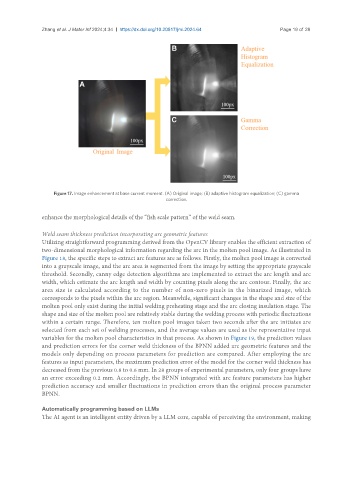
                   Figure 17. Image enhancement at base current moment. (A) Original image; (B) adaptive histogram equalization; (C) gamma
                                                         correction.

               enhance the morphological details of the “fish scale pattern” of the weld seam.

               Weld seam thickness prediction incorporating arc geometric features
               Utilizing straightforward programming derived from the OpenCV library enables the efficient extraction of
               two-dimensional morphological information regarding the arc in the molten pool image. As illustrated in
               Figure 18, the specific steps to extract arc features are as follows. Firstly, the molten pool image is converted
               into a grayscale image, and the arc area is segmented from the image by setting the appropriate grayscale
               threshold. Secondly, canny edge detection algorithms are implemented to extract the arc length and arc
               width, which estimate the arc length and width by counting pixels along the arc contour. Finally, the arc
               area size is calculated according to the number of non-zero pixels in the binarized image, which
               corresponds to the pixels within the arc region. Meanwhile, significant changes in the shape and size of the
               molten pool only exist during the initial welding preheating stage and the arc closing insulation stage. The
               shape and size of the molten pool are relatively stable during the welding process with periodic fluctuations
               within a certain range. Therefore, ten molten pool images taken two seconds after the arc initiates are
               selected from each set of welding processes, and the average values are used as the representative input
               variables for the molten pool characteristics in that process. As shown in Figure 19, the prediction values
               and prediction errors for the corner weld thickness of the BPNN added arc geometric features and the
               models only depending on process parameters for prediction are compared. After employing the arc
               features as input parameters, the maximum prediction error of the model for the corner weld thickness has
               decreased from the previous 0.8 to 0.6 mm. In 28 groups of experimental parameters, only four groups have
               an error exceeding 0.2 mm. Accordingly, the BPNN integrated with arc feature parameters has higher
               prediction accuracy and smaller fluctuations in prediction errors than the original process parameter
               BPNN.


               Automatically programming based on LLMs
               The AI agent is an intelligent entity driven by a LLM core, capable of perceiving the environment, making

