


Page 159 - Read Online
P. 159
Wang et al. J. Mater. Inf. 2026, 6, 13                                            Page 3 of 19


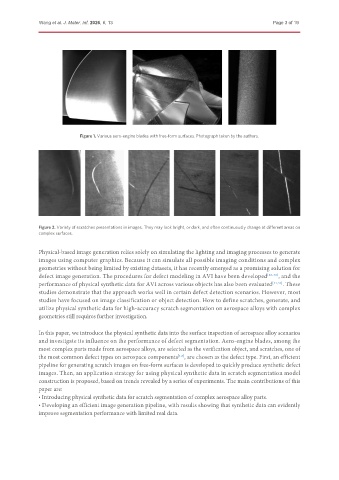
                             Figure 1. Various aero-engine blades with free-form surfaces. Photograph taken by the authors.


               Figure 2. Variety of scratches presentations in images. They may look bright, or dark, and often continuously change at different areas on
               complex surfaces.


               Physical-based image generation relies solely on simulating the lighting and imaging processes to generate
               images using computer graphics. Because it can simulate all possible imaging conditions and complex
               geometries without being limited by existing datasets, it has recently emerged as a promising solution for
               defect image generation. The procedures for defect modeling in AVI have been developed [26-30] , and the
               performance of physical synthetic data for AVI across various objects has also been evaluated [31,32] . These
               studies demonstrate that the approach works well in certain defect detection scenarios. However, most
               studies have focused on image classification or object detection. How to define scratches, generate, and
               utilize physical synthetic data for high-accuracy scratch segmentation on aerospace alloys with complex
               geometries still requires further investigation.


               In this paper, we introduce the physical synthetic data into the surface inspection of aerospace alloy scenarios
               and investigate its influence on the performance of defect segmentation. Aero-engine blades, among the
               most complex parts made from aerospace alloys, are selected as the verification object, and scratches, one of
               the most common defect types on aerospace components , are chosen as the defect type. First, an efficient
                                                                [1,5]
               pipeline for generating scratch images on free-form surfaces is developed to quickly produce synthetic defect
               images. Then, an application strategy for using physical synthetic data in scratch segmentation model
               construction is proposed, based on trends revealed by a series of experiments. The main contributions of this
               paper are:
               • Introducing physical synthetic data for scratch segmentation of complex aerospace alloy parts.
               • Developing an efficient image generation pipeline, with results showing that synthetic data can evidently
               improve segmentation performance with limited real data.

