


Page 157 - Read Online
P. 157
Research Article  |  Open Access

                          Journal of Materials Informatics


                                         Wang et al. J. Mater. Inf. 2026, 6, 13      DOI:10.20517/jmi.2025.74


               Physically synthesized data for deep learning-based
               visual scratch inspection of aerospace alloys with
               complex geometries


               Yuanbin Wang 1,2,3 , Yupeng Bai , Peng Wang , Wenhu Wang 1,2,3 , Mingzhu Zhu 5,6,* , Ming Luo 1,2,3
                                                    4
                                        1
               Keywords:
               Automatic visual inspection,
               physical image synthesis,
               defect segmentation, deep
               learning, aerospace alloys
               Citation: Wang, Y.; Bai, Y.;
               Wang, P.; Wang, W.;
               Zhu, M.; Luo, M. Physically
               synthesized data for deep
               learning-based visual
               scratch inspection of
               aerospace alloys with
               complex geometries. J.
               Mater. Inf. 2026, 6, 13.
               https://dx.doi.org/10.20517
               /jmi.2025.74

               Received: 28 Aug 2025  Abstract
               First Decision: 29 Oct
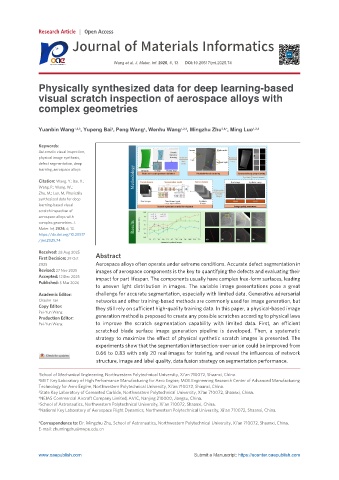
               2025                Aerospace alloys often operate under extreme conditions. Accurate defect segmentation in
               Revised: 27 Nov 2025  images of aerospace components is the key to quantifying the defects and evaluating their
               Accepted: 12 Dec 2025  impact for part lifespan. The components usually have complex free-form surfaces, leading
               Published: 5 Mar 2026
                                   to   uneven   light   distribution   in   images.   The   variable   image   presentations   pose   a   great
               Academic Editor:    challenge for accurate segmentation, especially with limited data. Generative adversarial
               Chaolin Tan         networks and other training-based methods are commonly used for image generation, but
               Copy Editor:        they still rely on sufficient high-quality training data. In this paper, a physical-based image
               Pei-Yun Wang        generation method is proposed to create any possible scratches according to physical laws
               Production Editor:
               Pei-Yun Wang        to   improve   the   scratch   segmentation   capability   with   limited   data.   First,   an   efficient
                                   scratched   blade   surface   image   generation   pipeline   is   developed.   Then,   a   systematic
                                   strategy  to  maximize  the  effect  of  physical  synthetic  scratch  images  is  presented.  The
                                   experiments show that the segmentation intersection-over-union could be improved from
                                   0.66 to 0.83 with only 20 real images for training, and reveal the influences of network

                                   structure, image and label quality, data fusion strategy on segmentation performance.

               1 School of Mechanical Engineering, Northwestern Polytechnical University, Xi’an 710072, Shaanxi, China.
               2 MIIT Key Laboratory of High Performance Manufacturing for Aero Engine; MOE Engineering Research Center of Advanced Manufacturing
               Technology for Aero Engine, Northwestern Polytechnical University, Xi’an 710072, Shaanxi, China.
               3 State Key Laboratory of Cemented Carbide, Northwestern Polytechnical University, Xi’an 710072, Shaanxi, China.
               4 NEIAS Commercial Aircraft Company Limited, AVIC, Nanjing 210000, Jiangsu, China.
               5 School of Astronautics, Northwestern Polytechnical University, Xi’an 710072, Shaanxi, China.
               6 National Key Laboratory of Aerospace Flight Dynamics, Northwestern Polytechnical University, Xi’an 710072, Shaanxi, China.

               * Correspondence to: Dr. Mingzhu Zhu, School of Astronautics, Northwestern Polytechnical University, Xi’an 710072, Shaanxi, China.
               E-mail: zhumingzhu@nwpu.edu.cn


               www.oaepublish.com                                    Submit a Manuscript: https://ucenter.oaepublish.com

