


Page 11 - Read Online
P. 11
Schertzer et al. J. Mater. Inf. 2025, 5, 5  https://dx.doi.org/10.20517/jmi.2024.69  Page 5 of 17


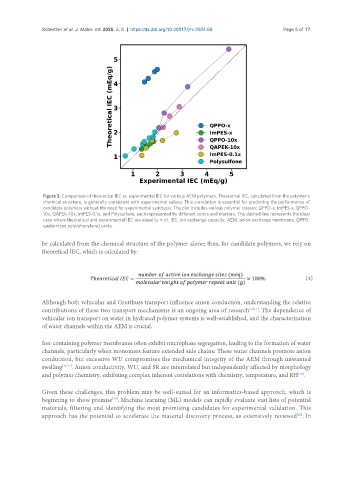
                Figure 3. Comparison of theoretical IEC vs. experimental IEC for various AEM polymers. Theoretical IEC, calculated from the polymer’s
                chemical structure, is generally consistent with experimental values. This correlation is essential for predicting the performance of
                candidate polymers without the need for experimental synthesis. The plot includes various polymer classes: QPPO-x, ImPES-x, QPPO-
                10x, QAPEK-10x, ImPES-0.1x, and Polysulfone, each represented by different colors and markers. The dashed line represents the ideal
                case where theoretical and experimental IEC are equal (y = x). IEC: Ion exchange capacity; AEM: anion exchange membrane; QPPO:
                quaternized poly(phenylene) oxide.

               be calculated from the chemical structure of the polymer alone; thus, for candidate polymers, we rely on
               theoretical IEC, which is calculated by:


                                                                                                        (3)


               Although both vehicular and Grotthuss transport influence anion conduction, understanding the relative
               contributions of these two transport mechanisms is an ongoing area of research [10,11] . The dependence of
               vehicular ion transport on water in hydrated polymer systems is well-established, and the characterization
               of water channels within the AEM is crucial.

               Ion-containing polymer membranes often exhibit microphase segregation, leading to the formation of water
               channels, particularly when monomers feature extended side chains. These water channels promote anion
               conduction, but excessive WU compromises the mechanical integrity of the AEM through unwanted
               swelling [16,17] . Anion conductivity, WU, and SR are interrelated but independently affected by morphology
                                                                                                      [18]
               and polymer chemistry, exhibiting complex inherent correlations with chemistry, temperature, and RH .

               Given these challenges, this problem may be well-suited for an informatics-based approach, which is
               beginning to show promise . Machine learning (ML) models can rapidly evaluate vast lists of potential
                                       [19]
               materials, filtering and identifying the most promising candidates for experimental validation. This
               approach has the potential to accelerate the material discovery process, as extensively reviewed . In
                                                                                                     [20]

