


Page 9 - Read Online
P. 9
Schertzer et al. J. Mater. Inf. 2025, 5, 5  https://dx.doi.org/10.20517/jmi.2024.69  Page 3 of 17


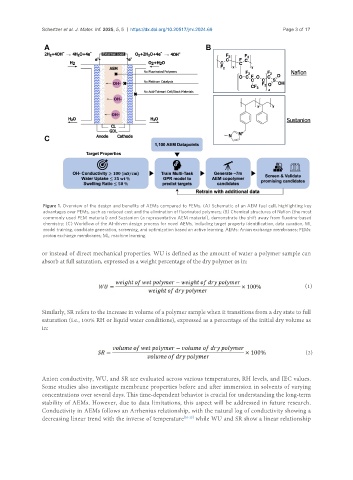
                Figure 1. Overview of the design and benefits of AEMs compared to PEMs. (A) Schematic of an AEM fuel cell, highlighting key
                advantages over PEMs, such as reduced cost and the elimination of fluorinated polymers; (B) Chemical structures of Nafion (the most
                commonly used PEM material) and Sustanion (a representative AEM material), demonstrate the shift away from fluorine-based
                chemistry; (C) Workflow of the AI-driven design process for novel AEMs, including target property identification, data curation, ML
                model training, candidate generation, screening, and optimization based on active learning. AEMs: Anion exchange membranes; PEMs:
                proton exchange membranes; ML: machine learning.

               or instead of direct mechanical properties. WU is defined as the amount of water a polymer sample can
               absorb at full saturation, expressed as a weight percentage of the dry polymer as in:


                                                                                                        (1)


               Similarly, SR refers to the increase in volume of a polymer sample when it transitions from a dry state to full
               saturation (i.e., 100% RH or liquid water conditions), expressed as a percentage of the initial dry volume as
               in:


                                                                                                        (2)


               Anion conductivity, WU, and SR are evaluated across various temperatures, RH levels, and IEC values.
               Some studies also investigate membrane properties before and after immersion in solvents of varying
               concentrations over several days. This time-dependent behavior is crucial for understanding the long-term
               stability of AEMs. However, due to data limitations, this aspect will be addressed in future research.
               Conductivity in AEMs follows an Arrhenius relationship, with the natural log of conductivity showing a
               decreasing linear trend with the inverse of temperature [10-12]  while WU and SR show a linear relationship

