


Page 10 - Read Online
P. 10
Page 4 of 17                     Schertzer et al. J. Mater. Inf. 2025, 5, 5  https://dx.doi.org/10.20517/jmi.2024.69


                                                                         -
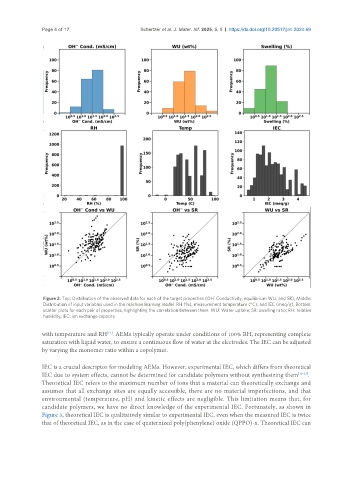
                Figure 2. Top: Distribution of the observed data for each of the target properties (OH  Conductivity, equilibrium WU, and SR), Middle:
                Distribution of input variables used in the machine learning model: RH (%), measurement temperature (°C), and IEC (meq/g), Bottom:
                scatter plots for each pair of properties, highlighting the correlation between them. WU: Water uptake; SR: swelling ratio; RH: relative
                humidity; IEC: ion exchange capacity.


               with temperature and RH . AEMs typically operate under conditions of 100% RH, representing complete
                                     [12]
               saturation with liquid water, to ensure a continuous flow of water at the electrodes. The IEC can be adjusted
               by varying the monomer ratio within a copolymer.

               IEC is a crucial descriptor for modeling AEMs. However, experimental IEC, which differs from theoretical
               IEC due to system effects, cannot be determined for candidate polymers without synthesizing them [13-15] .
               Theoretical IEC refers to the maximum number of ions that a material can theoretically exchange and
               assumes that all exchange sites are equally accessible, there are no material imperfections, and that
               environmental (temperature, pH) and kinetic effects are negligible. This limitation means that, for
               candidate polymers, we have no direct knowledge of the experimental IEC. Fortunately, as shown in
               Figure 3, theoretical IEC is qualitatively similar to experimental IEC, even when the measured IEC is twice
               that of theoretical IEC, as in the case of quaternized poly(phenylene) oxide (QPPO)-x. Theoretical IEC can

