


Page 106 - Read Online
P. 106
Page 8 of 15                         Niu et al. J. Mater. Inf. 2025, 5, 45  https://dx.doi.org/10.20517/jmi.2025.22


                                                                    3
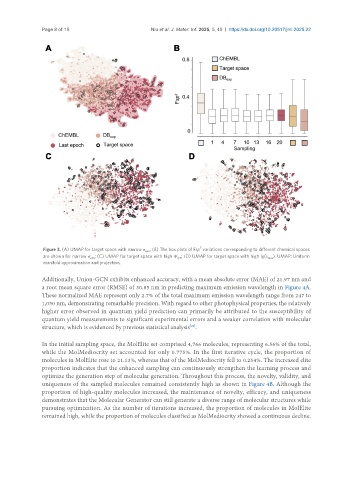
                Figure 3. (A) UMAP for target space with narrow σ ; (B) The box plots of Fsp  variations corresponding to different chemical spaces
                                                  emi
                are shown for narrow σ ; (C) UMAP for target space with high Φ ; (D) UMAP for target space with high lg(ε max ). UMAP: Uniform
                               emi
                                                             QY
                manifold approximation and projection.
               Additionally, Union-GCN exhibits enhanced accuracy, with a mean absolute error (MAE) of 21.97 nm and
               a root mean square error (RMSE) of 30.85 nm in predicting maximum emission wavelength in Figure 4A.
               These normalized MAE represent only 2.7% of the total maximum emission wavelength range from 247 to
               1,050 nm, demonstrating remarkable precision. With regard to other photophysical properties, the relatively
               higher error observed in quantum yield prediction can primarily be attributed to the susceptibility of
               quantum yield measurements to significant experimental errors and a weaker correlation with molecular
               structure, which is evidenced by previous statistical analysis .
                                                                 [26]

               In the initial sampling space, the MolElite set comprised 4,766 molecules, representing 6.56% of the total,
               while the MolMediocrity set accounted for only 0.775%. In the first iterative cycle, the proportion of
               molecules in MolElite rose to 21.13%, whereas that of the MolMediocrity fell to 0.254%. The increased elite
               proportion indicates that the enhanced sampling can continuously strengthen the learning process and
               optimize the generation step of molecular generation. Throughout this process, the novelty, validity, and
               uniqueness of the sampled molecules remained consistently high as shown in Figure 4B. Although the
               proportion of high-quality molecules increased, the maintenance of novelty, efficacy, and uniqueness
               demonstrates that the Molecular Generator can still generate a diverse range of molecular structures while
               pursuing optimization. As the number of iterations increased, the proportion of molecules in MolElite
               remained high, while the proportion of molecules classified as MolMediocrity showed a continuous decline.

