


Page 93 - Read Online
P. 93
Shu et al. J. Mater. Inf. 2025, 5, 36  https://dx.doi.org/10.20517/jmi.2025.13  Page 17 of 31


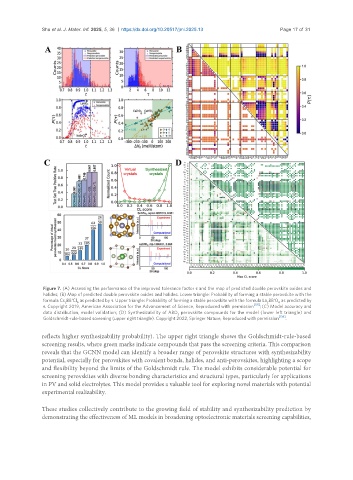
                Figure 7. (A) Assessing the performance of the improved tolerance factor τ and the map of predicted double perovskite oxides and
                halides; (B) Map of predicted double perovskite oxides and halides. Lower triangle: Probability of forming a stable perovskite with the
                formula Cs BB′Cl  as predicted by τ. Upper triangle: Probability of forming a stable perovskite with the formula La BB′O  as predicted by
                       2   6                                                               2   6
                                                                                       [135]
                τ. Copyright 2019, American Association for the Advancement of Science, Reproduced with  permission  ; (C) Model accuracy and
                data distribution, model validation; (D) Synthesizability of ABO  perovskite compounds for the model (lower left triangle) and
                                                             3
                Goldschmidt-rule-based screening (upper right triangle). Copyright 2022, Springer Nature, Reproduced with permission [136] .
               reflects higher synthesizability probability). The upper right triangle shows the Goldschmidt-rule-based
               screening results, where green marks indicate compounds that pass the screening criteria. This comparison
               reveals that the GCNN model can identify a broader range of perovskite structures with synthesizability
               potential, especially for perovskites with covalent bonds, halides, and anti-perovskites, highlighting a scope
               and flexibility beyond the limits of the Goldschmidt rule. The model exhibits considerable potential for
               screening perovskites with diverse bonding characteristics and structural types, particularly for applications
               in PV and solid electrolytes. This model provides a valuable tool for exploring novel materials with potential
               experimental realizability.

               These studies collectively contribute to the growing field of stability and synthesizability prediction by
               demonstrating the effectiveness of ML models in broadening optoelectronic materials screening capabilities,

