


Page 91 - Read Online
P. 91
Shu et al. J. Mater. Inf. 2025, 5, 36  https://dx.doi.org/10.20517/jmi.2025.13  Page 15 of 31


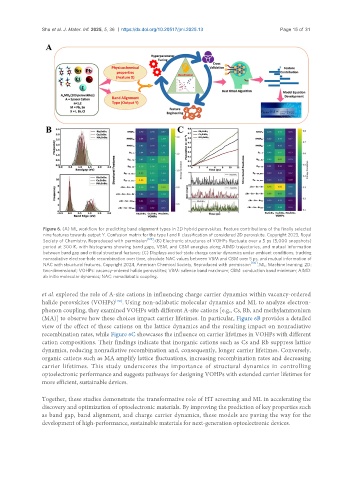
                Figure 6. (A) ML workflow for predicting band alignment types in 2D hybrid perovskites. Feature contributions of the finally selected
                nine features towards output Y. Confusion matrix for the type I and II classification of considered 2D perovskite. Copyright 2023, Royal
                Society of Chemistry, Reproduced with  permission [129] ; (B) Electronic structures of VOHPs fluctuate over a 5 ps (5,000 snapshots)
                period at 300 K, with histograms showing band gaps, VBM, and CBM energies along AIMD trajectories, and mutual information
                between band gap and critical structural features; (C) Displays excited-state charge carrier dynamics under ambient conditions, tracking
                nonradiative electron-hole recombination over time, absolute NAC values between VBM and CBM over 5 ps, and mutual information of
                NAC with structural features. Copyright 2024, American Chemical Society, Reproduced with permission [130] . ML: Machine learning; 2D:
                two-dimensional; VOHPs: vacancy-ordered halide perovskites; VBM: valence band maximum; CBM: conduction band minimum; AIMD:
                ab initio molecular dynamics; NAC: nonadiabatic coupling.

               et al. explored the role of A-site cations in influencing charge carrier dynamics within vacancy-ordered
               halide perovskites (VOHPs) . Using non-adiabatic molecular dynamics and ML to analyze electron-
                                        [130]
               phonon coupling, they examined VOHPs with different A-site cations [e.g., Cs, Rb, and methylammonium
               (MA)] to observe how these choices impact carrier lifetimes. In particular, Figure 6B provides a detailed
               view of the effect of these cations on the lattice dynamics and the resulting impact on nonradiative
               recombination rates, while Figure 6C showcases the influence on carrier lifetimes in VOHPs with different
               cation compositions. Their findings indicate that inorganic cations such as Cs and Rb suppress lattice
               dynamics, reducing nonradiative recombination and, consequently, longer carrier lifetimes. Conversely,
               organic cations such as MA amplify lattice fluctuations, increasing recombination rates and decreasing
               carrier  lifetimes.  This  study  underscores  the  importance  of  structural  dynamics  in  controlling
               optoelectronic performance and suggests pathways for designing VOHPs with extended carrier lifetimes for
               more efficient, sustainable devices.

               Together, these studies demonstrate the transformative role of HT screening and ML in accelerating the
               discovery and optimization of optoelectronic materials. By improving the prediction of key properties such
               as band gap, band alignment, and charge carrier dynamics, these models are paving the way for the
               development of high-performance, sustainable materials for next-generation optoelectronic devices.

