


Page 88 - Read Online
P. 88
Page 12 of 31                       Shu et al. J. Mater. Inf. 2025, 5, 36  https://dx.doi.org/10.20517/jmi.2025.13


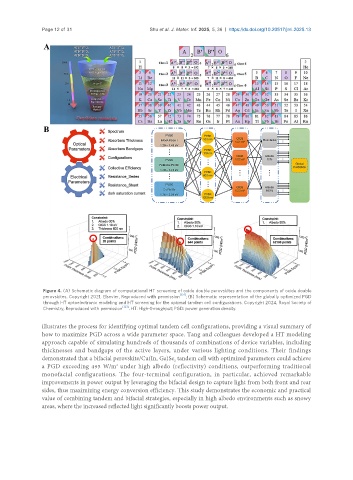
                Figure 4. (A) Schematic diagram of computational HT screening of oxide double perovskites and the components of oxide double
                perovskites. Copyright 2021, Elsevier, Reproduced with  permission [122] ; (B) Schematic representation of the globally optimized PGD
                through HT optoelectronic modeling and HT screening for the optimal tandem cell configurations. Copyright 2024, Royal Society of
                Chemistry, Reproduced with permission [123] . HT: High-throughput; PGD: power generation density.


               illustrates the process for identifying optimal tandem cell configurations, providing a visual summary of
               how to maximize PGD across a wide parameter space. Tang and colleagues developed a HT modeling
               approach capable of simulating hundreds of thousands of combinations of device variables, including
               thicknesses and bandgaps of the active layers, under various lighting conditions. Their findings
               demonstrated that a bifacial perovskite/Cu(In, Ga)Se  tandem cell with optimized parameters could achieve
                                                            2
               a PGD exceeding 495 W/m  under high albedo (reflectivity) conditions, outperforming traditional
                                        2
               monofacial configurations. The four-terminal configuration, in particular, achieved remarkable
               improvements in power output by leveraging the bifacial design to capture light from both front and rear
               sides, thus maximizing energy conversion efficiency. This study demonstrates the economic and practical
               value of combining tandem and bifacial strategies, especially in high albedo environments such as snowy
               areas, where the increased reflected light significantly boosts power output.

