


Page 30 - Read Online
P. 30
Liu et al. J Mater Inf 2024;4:33  https://dx.doi.org/10.20517/jmi.2024.48       Page 23 of 33


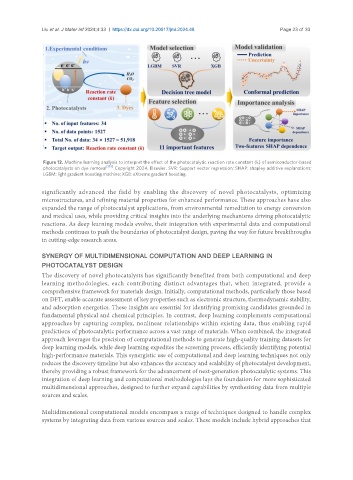
                Figure 12. Machine learning analysis to interpret the effect of the photocatalytic reaction rate constant (k) of semiconductor-based
                photocatalysts on dye  removal [153] . Copyright 2024, Elsevier. SVR: Support vector regression; SHAP: shapley additive explanations;
                LGBM: light gradient boosting machine; XGB: eXtreme gradient boosting.


               significantly  advanced  the  field  by  enabling  the  discovery  of  novel  photocatalysts,  optimizing
               microstructures, and refining material properties for enhanced performance. These approaches have also
               expanded the range of photocatalyst applications, from environmental remediation to energy conversion
               and medical uses, while providing critical insights into the underlying mechanisms driving photocatalytic
               reactions. As deep learning models evolve, their integration with experimental data and computational
               methods continues to push the boundaries of photocatalyst design, paving the way for future breakthroughs
               in cutting-edge research areas.

               SYNERGY OF MULTIDIMENSIONAL COMPUTATION AND DEEP LEARNING IN
               PHOTOCATALYST DESIGN
               The discovery of novel photocatalysts has significantly benefited from both computational and deep
               learning methodologies, each contributing distinct advantages that, when integrated, provide a
               comprehensive framework for materials design. Initially, computational methods, particularly those based
               on DFT, enable accurate assessment of key properties such as electronic structure, thermodynamic stability,
               and adsorption energetics. These insights are essential for identifying promising candidates grounded in
               fundamental physical and chemical principles. In contrast, deep learning complements computational
               approaches by capturing complex, nonlinear relationships within existing data, thus enabling rapid
               predictions of photocatalytic performance across a vast range of materials. When combined, the integrated
               approach leverages the precision of computational methods to generate high-quality training datasets for
               deep learning models, while deep learning expedites the screening process, efficiently identifying potential
               high-performance materials. This synergistic use of computational and deep learning techniques not only
               reduces the discovery timeline but also enhances the accuracy and scalability of photocatalyst development,
               thereby providing a robust framework for the advancement of next-generation photocatalytic systems. This
               integration of deep learning and computational methodologies lays the foundation for more sophisticated
               multidimensional approaches, designed to further expand capabilities by synthesizing data from multiple
               sources and scales.


               Multidimensional computational models encompass a range of techniques designed to handle complex
               systems by integrating data from various sources and scales. These models include hybrid approaches that

