


Page 26 - Read Online
P. 26
Liu et al. J Mater Inf 2024;4:33  https://dx.doi.org/10.20517/jmi.2024.48       Page 19 of 33


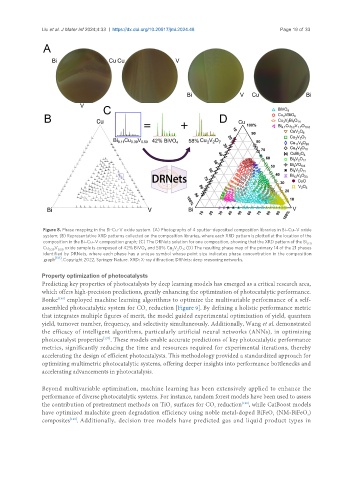
                Figure 8. Phase mapping in the Bi-Cu-V oxide system. (A) Photographs of 4 sputter-deposited composition libraries in Bi–Cu–V oxide
                system; (B) Representative XRD patterns collected on the composition libraries, where each XRD pattern is plotted at the location of the
                composition in the Bi–Cu–V composition graph; (C) The DRNets solution for one composition, showing that the XRD pattern of the Bi
                                                                                                         0.11
                Cu 0.39 V 0.50  oxide sample is composed of 42% BiVO  and 58% Cu V O ; (D) The resulting phase map of the primary 14 of the 21 phases
                                                  4
                                                              7
                                                             2
                                                           2
                identified by DRNets, where each phase has a unique symbol whose point size indicates phase concentration in the composition
                graph [133] . Copyright 2022, Springer Nature. XRD: X-ray diffraction; DRNets: deep reasoning networks.
               Property optimization of photocatalysts
               Predicting key properties of photocatalysts by deep learning models has emerged as a critical research area,
               which offers high-precision predictions, greatly enhancing the optimization of photocatalytic performance.
                     [136]
               Bonke  employed machine learning algorithms to optimize the multivariable performance of a self-
               assembled photocatalytic system for CO  reduction [Figure 9]. By defining a holistic performance metric
                                                  2
               that integrates multiple figures of merit, the model guided experimental optimization of yield, quantum
               yield, turnover number, frequency, and selectivity simultaneously. Additionally, Wang et al. demonstrated
               the efficacy of intelligent algorithms, particularly artificial neural networks (ANNs), in optimizing
               photocatalyst properties . These models enable accurate predictions of key photocatalytic performance
                                    [137]
               metrics, significantly reducing the time and resources required for experimental iterations, thereby
               accelerating the design of efficient photocatalysts. This methodology provided a standardized approach for
               optimizing multimetric photocatalytic systems, offering deeper insights into performance bottlenecks and
               accelerating advancements in photocatalysis.


               Beyond multivariable optimization, machine learning has been extensively applied to enhance the
               performance of diverse photocatalytic systems. For instance, random forest models have been used to assess
               the contribution of pretreatment methods on TiO  surfaces for CO  reduction , while CatBoost models
                                                                                   [138]
                                                                         2
                                                           2
               have optimized malachite green degradation efficiency using noble metal-doped BiFeO  (NM-BiFeO )
                                                                                                         3
                                                                                             3
               composites . Additionally, decision tree models have predicted gas and liquid product types in
                         [139]

