


Page 28 - Read Online
P. 28
Liu et al. J Mater Inf 2024;4:33  https://dx.doi.org/10.20517/jmi.2024.48       Page 21 of 33


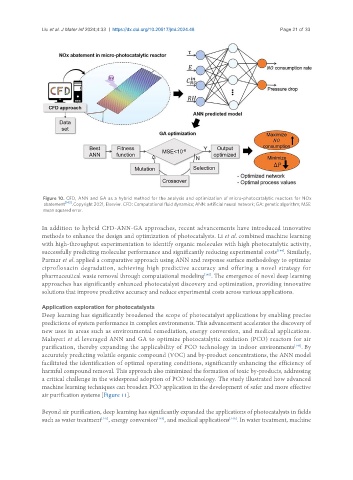
                Figure 10. CFD, ANN and GA as a hybrid method for the analysis and optimization of micro-photocatalytic reactors for NOx
                       [143]
                abatement  . Copyright 2021, Elsevier. CFD: Computational fluid dynamics; ANN: artificial neural network; GA: genetic algorithm; MSE:
                mean squared error.

               In addition to hybrid CFD-ANN-GA approaches, recent advancements have introduced innovative
               methods to enhance the design and optimization of photocatalysts. Li et al. combined machine learning
               with high-throughput experimentation to identify organic molecules with high photocatalytic activity,
                                                                                              [144]
               successfully predicting molecular performance and significantly reducing experimental costs . Similarly,
               Parmar et al. applied a comparative approach using ANN and response surface methodology to optimize
               ciprofloxacin degradation, achieving high predictive accuracy and offering a novel strategy for
               pharmaceutical waste removal through computational modeling . The emergence of novel deep learning
                                                                      [145]
               approaches has significantly enhanced photocatalyst discovery and optimization, providing innovative
               solutions that improve predictive accuracy and reduce experimental costs across various applications.

               Application exploration for photocatalysts
               Deep learning has significantly broadened the scope of photocatalyst applications by enabling precise
               predictions of system performance in complex environments. This advancement accelerates the discovery of
               new uses in areas such as environmental remediation, energy conversion, and medical applications.
               Malayeri et al. leveraged ANN and GA to optimize photocatalytic oxidation (PCO) reactors for air
                                                                                                    [146]
               purification, thereby expanding the applicability of PCO technology in indoor environments . By
               accurately predicting volatile organic compound (VOC) and by-product concentrations, the ANN model
               facilitated the identification of optimal operating conditions, significantly enhancing the efficiency of
               harmful compound removal. This approach also minimized the formation of toxic by-products, addressing
               a critical challenge in the widespread adoption of PCO technology. The study illustrated how advanced
               machine learning techniques can broaden PCO application in the development of safer and more effective
               air purification systems [Figure 11].


               Beyond air purification, deep learning has significantly expanded the applications of photocatalysts in fields
                                                                              [149]
               such as water treatment , energy conversion , and medical applications . In water treatment, machine
                                   [147]
                                                      [148]

