


Page 29 - Read Online
P. 29
Page 22 of 33                          Liu et al. J Mater Inf 2024;4:33  https://dx.doi.org/10.20517/jmi.2024.48


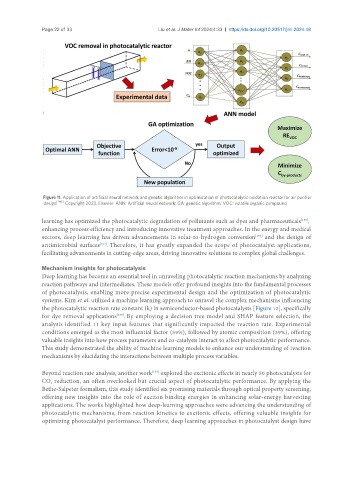
                Figure 11. Application of artificial neural network and genetic algorithm in optimization of photocatalytic oxidation reactor for air purifier
                design [146] . Copyright 2023, Elsevier. ANN: Artificial neural network; GA: genetic algorithm; VOC: volatile organic compound.


               learning has optimized the photocatalytic degradation of pollutants such as dyes and pharmaceuticals ,
                                                                                                      [150]
               enhancing process efficiency and introducing innovative treatment approaches. In the energy and medical
               sectors, deep learning has driven advancements in solar-to-hydrogen conversion  and the design of
                                                                                       [151]
                                   [152]
               antimicrobial surfaces . Therefore, it has greatly expanded the scope of photocatalyst applications,
               facilitating advancements in cutting-edge areas, driving innovative solutions to complex global challenges.

               Mechanism insights for photocatalysis
               Deep learning has become an essential tool in unraveling photocatalytic reaction mechanisms by analyzing
               reaction pathways and intermediates. These models offer profound insights into the fundamental processes
               of photocatalysis, enabling more precise experimental design and the optimization of photocatalytic
               systems. Kim et al. utilized a machine learning approach to unravel the complex mechanisms influencing
               the photocatalytic reaction rate constant (k) in semiconductor-based photocatalysts [Figure 12], specifically
               for dye removal applications . By employing a decision tree model and SHAP feature selection, the
                                        [153]
               analysis identified 11 key input features that significantly impacted the reaction rate. Experimental
               conditions emerged as the most influential factor (59%), followed by atomic composition (39%), offering
               valuable insights into how process parameters and co-catalysts interact to affect photocatalytic performance.
               This study demonstrated the ability of machine learning models to enhance our understanding of reaction
               mechanisms by elucidating the interactions between multiple process variables.


               Beyond reaction rate analysis, another work  explored the excitonic effects in nearly 50 photocatalysts for
                                                    [154]
               CO  reduction, an often overlooked but crucial aspect of photocatalytic performance. By applying the
                  2
               Bethe-Salpeter formalism, this study identified six promising materials through optical property screening,
               offering new insights into the role of exciton binding energies in enhancing solar-energy harvesting
               applications. The works highlighted how deep-learning approaches were advancing the understanding of
               photocatalytic mechanisms, from reaction kinetics to excitonic effects, offering valuable insights for
               optimizing photocatalyst performance. Therefore, deep learning approaches in photocatalyst design have

