


Page 65 - Read Online
P. 65
Page 6 of 25                        Meng et al. J. Mater. Inf. 2025, 5, 3  https://dx.doi.org/10.20517/jmi.2024.74


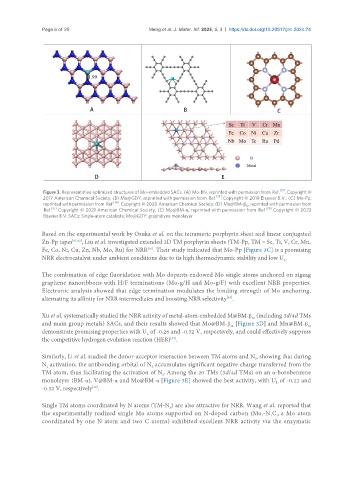
                Figure 3. Representative optimized structures of Mo-embedded SACs. (A) Mo-BN, reprinted with permission from Ref. [32] . Copyright ©
                2017 American Chemical Society; (B) Mo@GDY, reprinted with permission from  Ref. [35] . Copyright © 2019 Elsevier B.V.; (C) Mo-Pp,
                reprinted with permission from Ref. [36] . Copyright © 2020 American Chemical Society; (D) Mo@BM-β , reprinted with permission from
                                                                                    12
                Ref. [37] . Copyright © 2021 American Chemical Society; (E) Mo@BM-α, reprinted with permission from  Ref. [38] . Copyright © 2022
                Elsevier B.V. SACs: Single-atom catalysts; Mo@GDY: graphdiyne monolayer.

               Based on the experimental work by Osuka et al. on the tetrameric porphyrin sheet and linear conjugated
               Zn-Pp tapes [61,62] , Liu et al. investigated extended 2D TM porphyrin sheets (TM-Pp, TM = Sc, Ti, V, Cr, Mn,
               Fe, Co, Ni, Cu, Zn, Nb, Mo, Ru) for NRR . Their study indicated that Mo-Pp [Figure 3C] is a promising
                                                   [36]
               NRR electrocatalyst under ambient conditions due to its high thermodynamic stability and low U .
                                                                                                 L
               The combination of edge fluoridation with Mo dopants endowed Mo single atoms anchored on zigzag
               graphene nanoribbons with H/F terminations (Mo-g/H and Mo-g/F) with excellent NRR properties.
               Electronic analysis showed that edge termination modulates the binding strength of Mo anchoring,
               alternating its affinity for NRR intermediates and boosting NRR selectivity .
                                                                             [63]

               Xu et al. systematically studied the NRR activity of metal-atom-embedded M@BM-β  (including 3d/4d TMs
                                                                                      12
               and main group metals) SACs, and their results showed that Mo@BM-β  [Figure 3D] and Mn@BM-β
                                                                               12
                                                                                                         12
               demonstrate promising properties with U  of -0.26 and -0.32 V, respectively, and could effectively suppress
                                                   L
                                                           [37]
               the competitive hydrogen evolution reaction (HER) .
               Similarly, Li et al. studied the donor-acceptor interaction between TM atoms and N , showing that during
                                                                                       2
               N  activation, the antibonding orbital of N  accumulates significant negative charge transferred from the
                                                    2
                 2
               TM atom, thus facilitating the activation of N . Among the 20 TMs (3d/4d TMs) on an α-borobenzene
                                                        2
               monolayer (BM-α), V@BM-α and Mo@BM-α [Figure 3E] showed the best activity, with U  of -0.22 and
                                                                                              L
               -0.32 V, respectively .
                                [38]
               Single TM atoms coordinated by N atoms (TM-N ) are also attractive for NRR. Wang et al. reported that
                                                          x
               the experimentally realized single Mo atoms supported on N-doped carbon (Mo -N C , a Mo atom
                                                                                              2
                                                                                            1
                                                                                         1
               coordinated by one N atom and two C atoms) exhibited excellent NRR activity via the enzymatic

