


Page 64 - Read Online
P. 64
Meng et al. J. Mater. Inf. 2025, 5, 3  https://dx.doi.org/10.20517/jmi.2024.74   Page 5 of 25

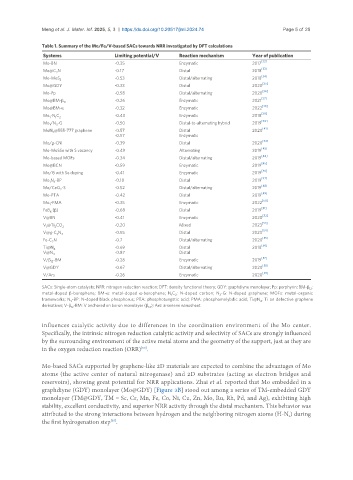
               Table 1. Summary of the Mo/Fe/V-based SACs towards NRR investigated by DFT calculations
                Systems                 Limiting potential/V  Reaction mechanism      Year of publication
                Mo-BN                   -0.35                Enzymatic                2017 [32]
                                                                                         [33]
                Mo@C N                  -0.17                Distal                   2018
                    2
                                                                                         [34]
                Mo-MoS 2                -0.53                Distal/alternating       2018
                                                                                          [35]
                Mo@GDY                  -0.33                Distal                   2020
                                                                                          [36]
                Mo-Pp                   -0.58                Distal/alternating       2020
                Mo@BM-β 12              -0.26                Enzymatic                2021 [37]
                                                                                         [38]
                Mo@BM-α                 -0.32                Enzymatic                2022
                Mo -N C                 -0.40                Enzymatic                2018 [39]
                  1
                    1 2
                                                                                         [40]
                Mo /N -G                -0.50                Distal-to-alternating hybrid  2019
                  1  3
                                                                                          [41]
                MoN @555-777 graphene   -0.57                Distal                   2020
                   3
                                        -0.57                Enzymatic
                                                                                          [42]
                Mo/g-CN                 -0.39                Distal                   2020
                Mo-MoSSe with S vacancy  -0.49               Alternating              2019 [43]
                                                                                         [44]
                Mo-based MOFs           -0.34                Distal/alternating       2019
                Mo@BCN                  -0.59                Enzymatic                2019 [45]
                                                                                         [46]
                Mo/G with Se doping     -0.41                Enzymatic                2019
                Mo N -BP                -0.18                Distal                   2019 [47]
                   3
                  1
                                                                                         [48]
                Mo/CeO -S               -0.52                Distal/alternating       2019
                     2
                Mo-PTA                  -0.42                Distal                   2019 [49]
                                                                                         [50]
                Mo -PMA                 -0.35                Enzymatic                2022
                  1
                                                                                         [51]
                FeB  (β)                -0.68                Distal                   2019
                  6
                V@BN                    -0.41                Enzymatic                2020 [52]
                                                                                         [53]
                V @Ti CO                -0.20                Mixed                    2023
                 1  2  2
                V@g-C N 4               -0.55                Distal                   2023 [54]
                    3
                                                                                          [55]
                Fe-C N                  -0.7                 Distal/alternating       2020
                   2
                Ti@N   4                -0.69                Distal                   2018 [56]
                V@N                     -0.87                Distal
                   4
                V/β -BM                 -0.28                Enzymatic                2019 [57]
                  12
                V@GDY                   -0.67                Distal/alternating       2020 [58]
                                                                                          [59]
                V/Ars                   -0.26                Enzymatic                2020
               SACs: Single-atom catalysts; NRR: nitrogen reduction reaction; DFT: density functional theory; GDY: graphdiyne monolayer; Pp: porphyrin; BM-β :
                                                                                                         12
               metal-doped  β-borophene;  BM-α:  metal-doped  α-borophene;  N C :  N-doped  carbon;  N -G:  N-doped  graphene;  MOFs:  metal-organic
                                                            2
                                                                           3
                                                           1
               frameworks; N -BP: N-doped black phosphorus; PTA: phosphotungstic acid; PMA: phosphomolybdic acid; Ti@N : Ti on defective graphene
                         3                                                               4
               derivatives; V-β -BM: V anchored on boron monolayer (β ); Ars: arsenene nanosheet.
                         12                        12
               influences catalytic activity due to differences in the coordination environment of the Mo center.
               Specifically, the intrinsic nitrogen reduction catalytic activity and selectivity of SACs are strongly influenced
               by the surrounding environment of the active metal atoms and the geometry of the support, just as they are
               in the oxygen reduction reaction (ORR) .
                                                 [60]
               Mo-based SACs supported by graphene-like 2D materials are expected to combine the advantages of Mo
               atoms (the active center of natural nitrogenase) and 2D substrates (acting as electron bridges and
               reservoirs), showing great potential for NRR applications. Zhai et al. reported that Mo embedded in a
               graphdiyne (GDY) monolayer (Mo@GDY) [Figure 3B] stood out among a series of TM-embedded GDY
               monolayer (TM@GDY, TM = Sc, Cr, Mn, Fe, Co, Ni, Cu, Zn, Mo, Ru, Rh, Pd, and Ag), exhibiting high
               stability, excellent conductivity, and superior NRR activity through the distal mechanism. This behavior was
               attributed to the strong interactions between hydrogen and the neighboring nitrogen atoms (H-N ) during
                                                                                                  2
                                      [35]
               the first hydrogenation step .

