


Page 63 - Read Online
P. 63
Page 4 of 25                        Meng et al. J. Mater. Inf. 2025, 5, 3  https://dx.doi.org/10.20517/jmi.2024.74


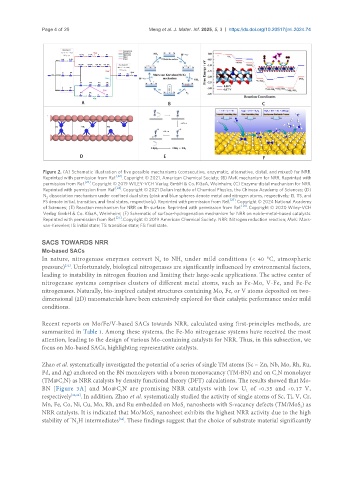
                Figure 2. (A) Schematic illustration of five possible mechanisms (consecutive, enzymatic, alternative, distal, and mixed) for NRR.
                Reprinted with permission from  Ref. [22] . Copyright © 2021, American Chemical Society; (B) MvK mechanism for NRR. Reprinted with
                permission from Ref. [23] . Copyright © 2019 WILEY-VCH Verlag GmbH & Co. KGaA, Weinheim; (C) Enzyme-distal mechanism for NRR.
                Reprinted with permission from Ref. [24] . Copyright © 2021 Dalian Institute of Chemical Physics, the Chinese Academy of Sciences; (D)
                N  dissociation mechanism under confined dual sites (pink and blue spheres denote metal and nitrogen atoms, respectively; IS, TS, and
                 2
                FS denote initial, transition, and final states, respectively). Reprinted with permission from Ref. [25] . Copyright © 2024 National Academy
                of Sciences; (E) Reaction mechanism for NRR on Rh surface. Reprinted with permission from  Ref. [26] . Copyright © 2020 Wiley-VCH
                Verlag GmbH & Co. KGaA, Weinheim; (F) Schematic of surface-hydrogenation mechanism for NRR on noble-metal-based catalysts.
                Reprinted with permission from Ref. [27] . Copyright © 2019 American Chemical Society. NRR: Nitrogen reduction reaction; MvK: Mars-
                van-Krevelen; IS: initial state; TS: transition state; FS: final state.

               SACS TOWARDS NRR
               Mo-based SACs
               In nature, nitrogenase enzymes convert N  to NH  under mild conditions (< 40 °C, atmospheric
                                                       2
                                                              3
               pressure) . Unfortunately, biological nitrogenases are significantly influenced by environmental factors,
                       [31]
               leading to instability in nitrogen fixation and limiting their large-scale applications. The active center of
               nitrogenase systems comprises clusters of different metal atoms, such as Fe-Mo, V-Fe, and Fe-Fe
               nitrogenases. Naturally, bio-inspired catalyst structures containing Mo, Fe, or V atoms deposited on two-
               dimensional (2D) nanomaterials have been extensively explored for their catalytic performance under mild
               conditions.

               Recent reports on Mo/Fe/V-based SACs towards NRR, calculated using first-principles methods, are
               summarized in Table 1. Among these systems, the Fe-Mo nitrogenase systems have received the most
               attention, leading to the design of various Mo-containing catalysts for NRR. Thus, in this subsection, we
               focus on Mo-based SACs, highlighting representative catalysts.


               Zhao et al. systematically investigated the potential of a series of single TM atoms (Sc ~ Zn, Nb, Mo, Rh, Ru,
               Pd, and Ag) anchored on the BN monolayers with a boron monovacancy (TM-BN) and on C N monolayer
                                                                                              2
               (TM@C N) as NRR catalysts by density functional theory (DFT) calculations. The results showed that Mo-
                      2
               BN  [Figure  3A]  and  Mo@C N  are  promising  NRR  catalysts  with  low  U   of  -0.35  and  -0.17  V,
                                                                                    L
                                          2
               respectively [32,33] . In addition, Zhao et al. systematically studied the activity of single atoms of Sc, Ti, V, Cr,
               Mn, Fe, Co, Ni, Cu, Mo, Rh, and Ru embedded on MoS  nanosheets with S-vacancy defects (TM/MoS ) as
                                                                                                      2
                                                               2
               NRR catalysts. It is indicated that Mo/MoS  nanosheet exhibits the highest NRR activity due to the high
                                                     2
               stability of  N H intermediates . These findings suggest that the choice of substrate material significantly
                         *
                                         [34]
                           2

