


Page 70 - Read Online
P. 70
Meng et al. J. Mater. Inf. 2025, 5, 3  https://dx.doi.org/10.20517/jmi.2024.74  Page 11 of 25


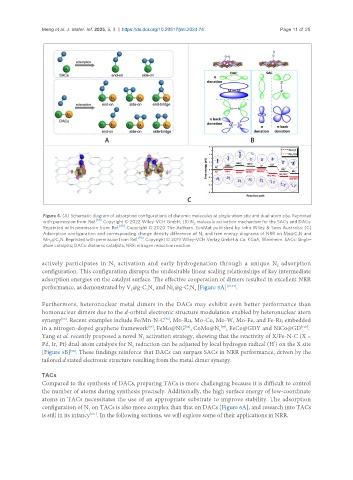
                Figure 4. (A) Schematic diagram of adsorption configurations of diatomic molecules at single-atom site and dual-atom site. Reprinted
                with permission from  Ref. [88] . Copyright © 2022 Wiley-VCH GmbH; (B) N  molecule activation mechanism for the SACs and DACs.
                                                                  2
                Reprinted with permission from  Ref. [89] . Copyright © 2020 The Authors. EcoMat published by John Wiley & Sons Australia; (C)
                Adsorption configuration and corresponding charge density difference of N  and free energy diagrams of NRR on Mn@C N and
                                                                                                     2
                                                                     2
                Mn @C N. Reprinted with permission from Ref. [90] . Copyright © 2019 Wiley-VCH Verlag GmbH & Co. KGaA, Weinheim. SACs: Single-
                     2
                  2
                atom catalysts; DACs: diatomic catalysts; NRR: nitrogen reduction reaction.
               actively  participates  in  N   activation  and  early  hydrogenation  through  a  unique  N   adsorption
                                       2
                                                                                              2
               configuration. This configuration disrupts the undesirable linear scaling relationships of key intermediate
               adsorption energies on the catalyst surface. The effective cooperation of dimers resulted in excellent NRR
               performance, as demonstrated by V @g-C N  and Ni @g-C N  [Figure 5A] [93,94] .
                                                    4
                                             2
                                                  3
                                                           2
                                                                   4
                                                                 3
               Furthermore, heteronuclear metal dimers in the DACs may exhibit even better performance than
               homonuclear dimers due to the d-orbital electronic structure modulation enabled by heteronuclear atom
               synergy . Recent examples include Fe/Mn-N-C , Mo-Ru, Mo-Co, Mo-W, Mo-Fe, and Fe-Ru embedded
                                                        [96]
                      [95]
                                                                           [99]
                                                               [98]
                                                   [97]
               in a nitrogen-doped graphene framework , FeMo@NG , CoMo@N , FeCo@GDY and NiCo@GD .
                                                                                                      [100]
                                                                           6
               Yang et al. recently proposed a novel N  activation strategy, showing that the reactivity of X/Fe-N-C (X =
                                                 2
               Pd, Ir, Pt) dual-atom catalysts for N  reduction can be adjusted by local hydrogen radical (H ) on the X site
                                                                                             *
                                              2
               [Figure 5B] . These findings reinforce that DACs can surpass SACs in NRR performance, driven by the
                         [94]
               tailored d stated electronic structure resulting from the metal dimer synergy.
               TACs
               Compared to the synthesis of DACs, preparing TACs is more challenging because it is difficult to control
               the number of atoms during synthesis precisely. Additionally, the high surface energy of low-coordinate
               atoms in TACs necessitates the use of an appropriate substrate to improve stability. The adsorption
               configuration of N  on TACs is also more complex than that on DACs [Figure 6A], and research into TACs
                               2
               is still in its infancy . In the following sections, we will explore some of their applications in NRR.
                               [101]

