


Page 71 - Read Online
P. 71
Page 12 of 25                       Meng et al. J. Mater. Inf. 2025, 5, 3  https://dx.doi.org/10.20517/jmi.2024.74


                Figure 5. (A) Free energy profiles and corresponding intermediate structures on V @g-C N  andNi @g-C N , Color scheme: H, white; C,
                                                                      2
                                                                            4
                                                                           3
                                                                                       4
                                                                                     3
                                                                                 2
                gray; N, blue; V, red; Ni, pink. Reprinted with permission from Ref. [93] . Copyright © 2022 Wiley-VCH GmbH; (B) N≡N bond lengths with
                         *                                           a
                and without H  generated on the X site and the relationship between  G  and E NNH*  on X/Fe-N-C (X = Pd, Ir, Pt), with an inset showing
                                                                H*
                                                            *                         [94]
                the schematic diagram of the cleavage of X−H bond to form NNH . Reprinted with permission from  Ref.  . Copyright © 2023 Wiley-
                VCH GmbH.


                                                                                                       [101]
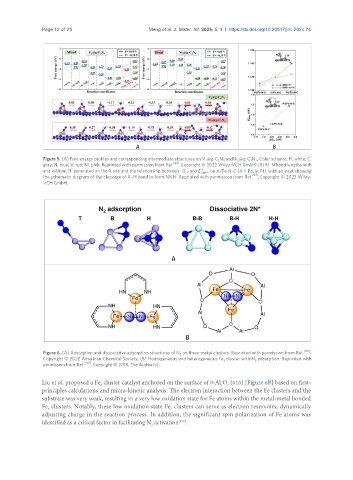
                Figure 6. (A) Adsorption and dissociative adsorption structures of N  on three-metal clusters. Reprinted with permission from Ref.  .
                                                              2
                Copyright © 2022 American Chemical Society; (B) Homogeneous and heterogeneous Fe  cluster with N  adsorption. Reprinted with
                                                                            3          2
                             [102]
                permission from Ref.  . Copyright © 2018, The Author(s).
               Liu et al. proposed a Fe  cluster catalyst anchored on the surface of θ-Al O  (010) [Figure 6B] based on first-
                                                                              3
                                                                           2
                                   3
               principles calculations and micro-kinetic analysis. The electron interaction between the Fe clusters and the
               substrate was very weak, resulting in a very low oxidation state for Fe atoms within the metal-metal bonded
               Fe  clusters. Notably, these low oxidation state Fe  clusters can serve as electron reservoirs, dynamically
                 3
                                                          3
               adjusting charge in the reaction process. In addition, the significant spin polarization of Fe atoms was
               identified as a critical factor in facilitating N  activation .
                                                             [102]
                                                    2

