


Page 54 - Read Online
P. 54
Li et al. J Mater Inf 2024;4:4  I http://dx.doi.org/10.20517/jmi.2023.41          Page 9 of 14


                                           Table 2. The structure of local environment ResNet
               Layer name                  Output size                      34-Layer
               Conv1                         6 × 11                      1 × 1, 32, stride 1
                                                                        "    #
                                                                        3 × 3, 32
               Conv2_x                       6 × 11                     3 × 3, 32  × 3, stride 1
                                                                        "    #
                                                                        3 × 3, 64
               Conv3_x                       3 × 6                      3 × 3, 64  × 4, stride 2
                                                                       "     #
                                                                        3 × 3, 128
               Conv4_x                       2 × 3                      3 × 3, 128  × 6, stride 2
                                                                       "     #
                                                                        3 × 3, 256
                                             1 × 2                            × 3, stride 2
               Conv5_x                                                  3 × 3, 256
                                             1 × 1                       AdaptiveAvgPool


                              0.4                                                       split
                                                                                            train
                                                                                            test
                              0.2


                                0
                           residual  −0.2


                             −0.4


                             −0.6

                                       −2        0          2         4
                                                 prediction


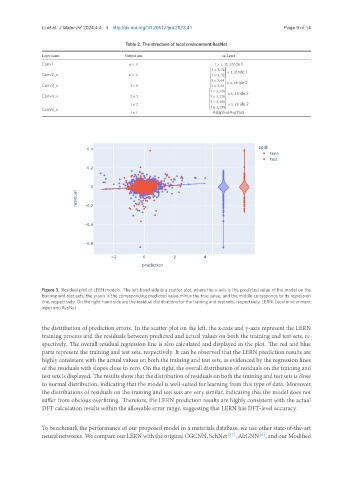
               Figure 3. Residual plot of LERN models. The left-hand side is a scatter plot, where the x-axis is the predicted value of the model on the
               training and test sets, the y-axis is the corresponding predicted value minus the true value, and the middle corresponds to its regression
               line, respectively. On the right-hand side are the residual distributions for the training and test sets, respectively. LERN: Local environment
               input into ResNet.


               the distribution of prediction errors. In the scatter plot on the left, the x-axis and y-axis represent the LERN
               training process and the residuals between predicted and actual values on both the training and test sets, re-
               spectively. The overall residual regression line is also calculated and displayed in the plot. The red and blue
               parts represent the training and test sets, respectively. It can be observed that the LERN prediction results are
               highly consistent with the actual values on both the training and test sets, as evidenced by the regression lines
               of the residuals with slopes close to zero. On the right, the overall distribution of residuals on the training and
               testsetsisdisplayed. Theresultsshowthatthedistributionofresidualsonboththetrainingandtestsetsisclose
               to normal distribution, indicating that the model is well-suited for learning from this type of data. Moreover,
               the distributions of residuals on the training and test sets are very similar, indicating that the model does not
               suffer from obvious overfitting. Therefore, the LERN prediction results are highly consistent with the actual
               DFT calculation results within the allowable error range, suggesting that LERN has DFT-level accuracy.


               To benchmark the performance of our proposed model in a materials database, we use other state-of-the-art
                                                                                         [6]
               neural networks. We compare our LERN with the original CGCNN, SchNet [57] , AliGNN , and our Modified

