


Page 52 - Read Online
P. 52
Li et al. J Mater Inf 2024;4:4  I http://dx.doi.org/10.20517/jmi.2023.41          Page 7 of 14


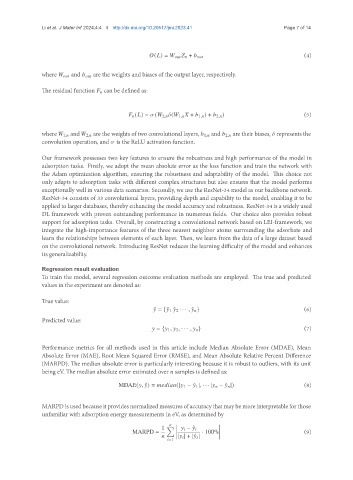
                                                                                                        (4)
                                                     (  ) =                 +

               where           and           are the weights and biases of the output layer, respectively.

               The residual function       can be defined as:


                                                  (  ) =   (   2,     (   1,      +    1,   ) +    2,   )  (5)

               where    1,   and    2,   are the weights of two convolutional layers,    1,   and    2,   are their biases,    represents the
               convolution operation, and    is the ReLU activation function.

               Our framework possesses two key features to ensure the robustness and high performance of the model in
               adsorption tasks. Firstly, we adopt the mean absolute error as the loss function and train the network with
               the Adam optimization algorithm, ensuring the robustness and adaptability of the model. This choice not
               only adapts to adsorption tasks with different complex structures but also ensures that the model performs
               exceptionally well in various data scenarios. Secondly, we use the ResNet-34 model as our backbone network.
               ResNet-34 consists of 33 convolutional layers, providing depth and capability to the model, enabling it to be
               applied to larger databases, thereby enhancing the model accuracy and robustness. ResNet-34 is a widely used
               DL framework with proven outstanding performance in numerous fields. Our choice also provides robust
               support for adsorption tasks. Overall, by constructing a convolutional network based on LEI-framework, we
               integrate the high-importance features of the three nearest neighbor atoms surrounding the adsorbate and
               learn the relationships between elements of each layer. Then, we learn from the data of a large dataset based
               on the convolutional network. Introducing ResNet reduces the learning difficulty of the model and enhances
               its generalizability.

               Regression result evaluation
               To train the model, several regression outcome evaluation methods are employed. The true and predicted
               values in the experiment are denoted as:

               True value:

                                                     ˆ    = { ˆ   1 ˆ   2 · · · , ˆ      }              (6)
               Predicted value:
                                                       = {   1 ,    2 , · · · ,       }                 (7)

               Performance metrics for all methods used in this article include Median Absolute Error (MDAE), Mean
               Absolute Error (MAE), Root Mean Squared Error (RMSE), and Mean Absolute Relative Percent Difference
               (MARPD). The median absolute error is particularly interesting because it is robust to outliers, with its unit
               being eV. The median absolute error estimated over    samples is defined as:


                                         MDAE(  , ˆ  ) =             (|   1 − ˆ   1 |, · · · |      − ˆ      |)  (8)


               MARPD is used because it provides normalized measures of accuracy that may be more interpretable for those
               unfamiliar with adsorption energy measurements in eV, as determined by


                                                        1  Õ         − ˆ
                                              MARPD =                · 100%                             (9)
                                                               |      | + | ˆ      |
                                                           =1

