


Page 48 - Read Online
P. 48
Li et al. J Mater Inf 2024;4:4  I http://dx.doi.org/10.20517/jmi.2023.41          Page 3 of 14


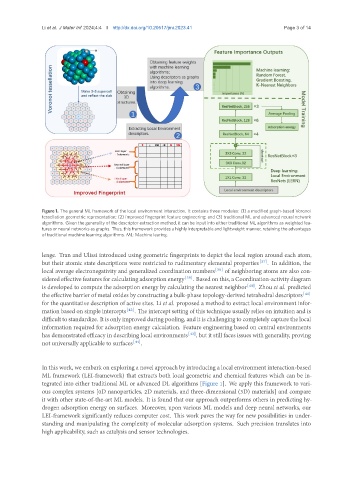
               Figure 1. The general ML framework of the local environment interaction. It contains three modules: (1) a modified graph-based Voronoi
               tessellation geometric representation; (2) improved fingerprint feature engineering; and (3) traditional ML and advanced neural network
               algorithms. Given the generality of the descriptor extraction method, it can be input into either traditional ML algorithms as weighted fea-
               tures or neural networks as graphs. Thus, this framework provides a highly interpretable and lightweight manner, retaining the advantages
               of traditional machine learning algorithms. ML: Machine learing.


               lenge. Tran and Ulissi introduced using geometric fingerprints to depict the local region around each atom,
               but their atomic state descriptions were restricted to rudimentary elemental properties [37] . In addition, the
               local average electronegativity and generalized coordination numbers [38]  of neighboring atoms are also con-
               sidered effective features for calculating adsorption energy [39] . Based on this, a Coordination-activity diagram
               is developed to compute the adsorption energy by calculating the nearest neighbor [40] . Zhou et al. predicted
               the effective barrier of metal oxides by constructing a bulk-phase topology-derived tetrahedral descriptors [41]
               for the quantitative description of active sites. Li et al. proposed a method to extract local environment infor-
               mation based on simple intercepts [42] . The intercept setting of this technique usually relies on intuition and is
               difficult to standardize. It is only improved during pooling, and it is challenging to completely capture the local
               information required for adsorption energy calculation. Feature engineering based on central environments
               has demonstrated efficacy in describing local environments [43] , but it still faces issues with generality, proving
               not universally applicable to surfaces [44] .


               In this work, we embark on exploring a novel approach by introducing a local environment interaction-based
               ML framework (LEI-framework) that extracts both local geometric and chemical features which can be in-
               tegrated into either traditional ML or advanced DL algorithms [Figure 1]. We apply this framework to vari-
               ous complex systems [0D nanoparticles, 2D materials, and three-dimensional (3D) materials] and compare
               it with other state-of-the-art ML models. It is found that our approach outperforms others in predicting hy-
               drogen adsorption energy on surfaces. Moreover, upon various ML models and deep neural networks, our
               LEI-framework significantly reduces computer cost. This work paves the way for new possibilities in under-
               standing and manipulating the complexity of molecular adsorption systems. Such precision translates into
               high applicability, such as catalysis and sensor technologies.

